
 Mosaicx
How to Build, Train, Test, and Deploy Conversational AI Solutions in 2026
Conversational AI is rapidly becoming a critical tool for businesses of all sizes. It can help businesses improve customer service, increase sales,...
.png)
The digital age has made customers extremely demanding. Over two-thirds now expect their support tickets to be resolved within hours, making first-contact resolution a major driver of positive customer experiences and competitive advantage.
Escalation management has a significant impact on how customers perceive your brand, directly influencing their purchasing decisions. It boosts your service quality for long-term engagements and new revenue opportunities, especially when paired with automation and aligned with customer expectations.
Customer escalation management is how you handle problems that your frontline team can't solve on their own. It moves issues to someone with more expertise, authority, or resources to fix them.
This isn't about admitting failure. It's about getting customers the help they actually need. Some problems require specialists. Some need someone who can bend the rules. Some customers won't accept anything less than a supervisor's attention.
Most companies try to keep escalation rates low, and that makes sense. High escalation volumes usually mean your frontline agents need better training or tools. But pushing escalations to zero isn't the answer either.
Sometimes escalating is exactly what you should do. A complex technical issue wastes everyone's time if a junior agent keeps trying to fix it. A security concern needs the security team, not a script-reading generalist.
The trick is knowing when to escalate and doing it fast. Hold onto cases too long and you make things worse. Pass everything up the chain and you overwhelm your senior staff with issues they shouldn't be handling.
Good escalation management means having clear triggers for when to move a case. It means your team knows exactly who to send it to. And it means the handoff happens without making the customer start over from scratch.
When you get this right, escalations stop feeling like failure. They become a tool for making sure every customer gets the level of support their situation actually needs.
Good customer escalation management shows up in your bottom line:
Most escalations don't happen out of the blue. They start small but gradually build up when customers reach a breaking point. Live agents trained to spot these trigger points help prevent problems from becoming larger issues.
Delayed responses set frustration in motion. Customers can't wait days for a reply. They want their answers as quickly as possible. Most businesses tend to have a 24-hour response window but customers often expect answers within minutes.
Unresolved problems compound over time. Someone who has called two times already will demand to speak with an agent who can actually solve their problem. Each failed attempt adds to their frustration.
System failures disrupt customer operations. Server downtimes, login issues, slow processing, etc, directly impact how customers use your product. These problems require immediate attention because they prevent customers from accessing services they've paid for.
Lack of agent empowerment blocks solutions. Most live agents aren't allowed to refund, compensate, or make exceptions on their own. They have to involve a supervisor who has the authority to make such decisions. Even though a customer might get a refund this way, the handoff ends up causing friction.
Organizations encounter different escalation management patterns based on how issues originate and what's needed to resolve them. Each type follows distinct workflows and requires specific resources.
System-side disruptions prevent a paying customer from completing their basic tasks. A scripted response from a live agent won't help here. These issues need to be quickly forwarded to technical teams who understand infrastructure.
Note that your live agent doesn't need to explain to frustrated customers that they can't fix a server outage. However, they can loop in the people who can, while keeping customers informed about progress.
Some problems need specialized knowledge that frontline agents simply don't have. A billing question about complex invoicing rules, a technical question about API integration, or a compliance inquiry about data processing requires expertise beyond standard training.
Functional escalation routes these cases to teams with the right skills instead of palming them to random agents who are only going to frustrate customers further.
These escalations involve supervisors or senior staff who can make judgment calls that frontline agents can't. They often involve requests for compensation, refunds, or policy exceptions.
For instance, a customer who's demanding a refund because your payment gateways were down. The frontline agent is not authorized to make such a call, so they bring in a manager who has the authority to grant a discount on the customer's next subscription or a similar offer to save the customer relationship.
Not every issue carries the same weight. A critical bug affecting an enterprise client is significantly different from a minor issue reported by a free user.
Similarly, an incident that could have a severe impact on revenue needs to skip the queue and go straight to senior management. This ensures critical problems get immediate attention while routine issues follow normal workflows.
You need structured processes, trained staff, and systems that catch problems early. The practices below help resolve issues faster while preventing future escalations.
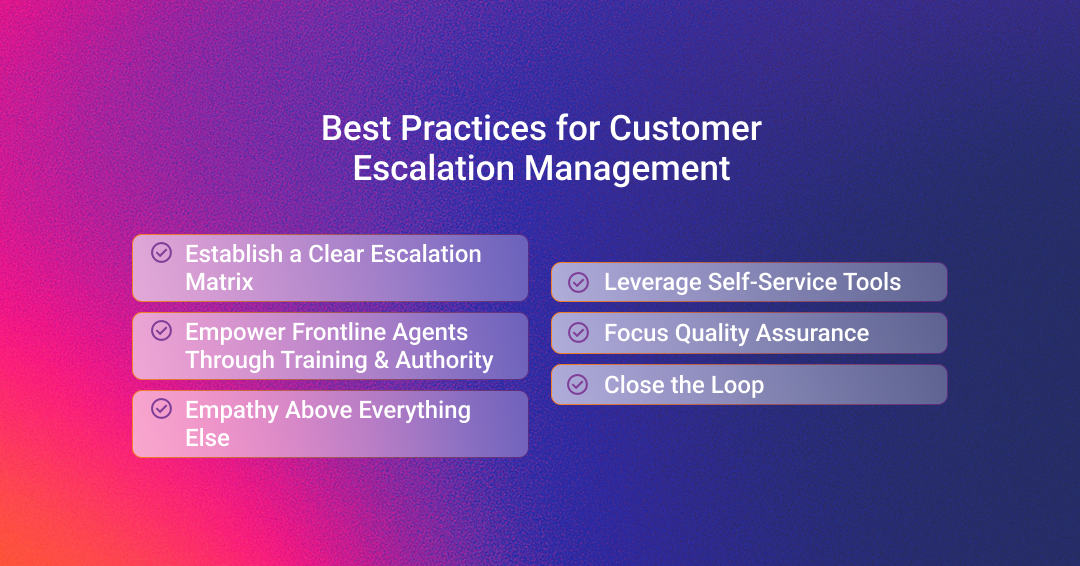
The matrix here sets the rules for every escalation. It defines who handles what and when issues move up the chain. Without this structure, complaint tickets keep bouncing between departments. Customers repeat themselves during every interaction, getting more frustrated as their resolution times stretch out.
Your live agents need instant access to this escalation matrix. When someone asks for a supervisor, the agent knows exactly who to contact and how to transfer the case. For example, billing problems go to finance and technical bugs go to engineering. Each path includes response time targets and escalation triggers.
Escalations should never happen in the first place. Agents who can solve problems during the first interaction play a major role in boosting customer satisfaction.
Issuing credits up to a certain amount or waiving fees in specific situations without asking for permission are small powers that prevent escalations that waste everyone's time.
However, this requires proper training. They need the knowledge to handle complex cases and to use their authority to make high-value decisions.
Someone calling in anger wants to feel heard before being told a solution. Your live support can lower the tension by simply acknowledging the problem and giving a clear explanation of what’s going on.
Regular updates often matter more than instant solutions. If an issue takes a few days to resolve, customers are far more patient when they’re kept in the loop. Silence, on the other hand, creates worry and erodes trust.
Also, always set realistic expectations from the start. If a fix takes 48 hours, say so. Honest, realistic expectations go a long way and customers are much more understanding when you deliver on what you promised.
Customers often want to solve their problems themselves. Giving them the tools to do so speeds up resolution and reduces unnecessary calls. Password resets, account updates, and basic troubleshooting don't require your best agents anyway. Clear knowledge bases and self-service portals are far more efficient in resolving routine issues at scale.
Every escalated case points to gaps in your service's training or workflows. It's why QA teams regularly review these interactions to spot recurring issues and coaching opportunities.
Some agents might be solving certain issues faster than others. Managers can look into their workflows and train the struggling agents accordingly. Tracking metrics like escalation rate by agent, common escalation reasons, and resolution time helps here. These numbers show which agents need support and which processes need fixing.
Follow up with customers to confirm their problem was actually solved. It might happen that their problem has returned or that the solution presented to them wasn't as efficient as they had expected.
Share escalation insights with the teams who can prevent them. If product bugs cause repeated escalations, engineering needs to know. If unclear policies confuse customers, update the documentation.
A working framework catches issues early, routes them correctly, and captures insights that prevent future problems. The escalation process follows six connected stages.
Warning signs appear before customers escalate. For example, a customer contacts support three times about the same issue or when wait times exceed your standard threshold.
These signals trigger alerts that prompt immediate action. Tickets approaching SLA breaches are flagged by automated systems, while dashboards show the accounts that are on the verge of leaving. Your agents even receive an alert when a customer shows signs of frustration.
Catching these issues early makes all the difference. Many issues can be resolved on the spot with a simple call from the manager. This ensures that the customer doesn't have to go out of their way to file a formal complaint.
Determine whether an escalation deserves to skip the queue. Your high-value accounts should always get priority. Issues affecting multiple customers should always move up the chain faster than individual complaints.
Have clear severity levels to guide your escalation assessment:
Managing customer escalation depends on getting each case to someone who can actually fix it. Your routing rules should match issue types to specialized teams based on the expertise needed.
Make sure one person owns each escalation from start to finish. They are then responsible for coordinating with other teams and updating the customer. This adds accountability.
Additionally, every time an escalation moves from one department to the next, both teams should document what's been tried and what needs to happen next.
Never give the customer false hopes. Begin with an acknowledgment of the problem and keep the customer updated. This routine communication should continue until a resolution is reached. The last communication should confirm the problem has been solved and give the customer a chance to confirm.
It’s good to document all the actions and all the conversations that take place. Documenting all these details will enable future agents to know the history in case the issue arises again. It will also protect the company from any dispute.
Have a dedicated team analyze your closed escalations to spot patterns. It might determine whether an escalation was preventable or whether a case would have been handled better.
Insights only matter if you act on them. Use your escalation data to improve products, update policies, and refine processes. It helps turn your escalation management into a continuous improvement cycle.
If data shows users struggle at a specific point in their journey, have your support contact them proactively with guidance. If a known issue affects certain accounts, notify them before they discover it themselves.
Self-service improvements work wonders here to reduce support volume. Your data trends might indicate several customers calling support for the same small issue. Move that fix into your self-service portal so customers can resolve it on their own.
Your escalation management process nets better results when paired with AI and automation. This removes the manual effort from the equation, allowing your agents to focus on high-value cases while giving other benefits.
Your front-line experience has the power to either make or break how customers see your brand. Mosaicx stands at that intersection, enabling organizations to turn moments of friction into resolution experiences that feel natural and responsive.
Engage is our conversational AI solution for better customer experiences. Its intelligent virtual agents (IVAs) automatically handle routine customer interactions without any need for human oversight.
Unlike traditional chatbots, our IVAs operate with a level of fluency and context awareness that feels human. They understand intent across voice, text, and chat, manage routine tasks, and escalate only when truly necessary.
Your business gets to see smarter escalations, shorter resolution times, and support experiences that leave customers confident they’re being heard.
Ready to see how smarter escalations can redefine your customer support? Schedule a demo and watch your service quality climb while your team works more effectively.

Conversational AI is rapidly becoming a critical tool for businesses of all sizes. It can help businesses improve customer service, increase sales,...

One of the most common pain points for any customer service business is the cost of unanswered calls. You not only frustrate your customers who might...
.png)
Modern contact centers operate in a fundamentally different environment than before. There's a long line of customers coming through multiple...