
 Mosaicx
How to Build, Train, Test, and Deploy Conversational AI Solutions in 2026
Conversational AI is rapidly becoming a critical tool for businesses of all sizes. It can help businesses improve customer service, increase sales,...
.png)
Every customer interaction generates data but most companies struggle to connect this information because it's scattered across different channels. You can't expect a customer to stick to your preferred channel, but you can use a customer experience platform (CXP) to pull and store all customer data in one place.
Hence, service teams can see the complete history across all channels and the unified customer profiles help them deliver personalized interactions.
CXPs are an integral part of modern businesses looking to improve customer satisfaction. Below, we break down how these platforms work and the benefits they deliver.
A customer experience platform manages all customer interactions across different channels from one central system. It pulls information from your website analytics, CRM database, support tickets, social media, purchase history, and any other connected system.
This data creates customer profiles that anyone on your team can access. So, marketing sees support issues, sales knows content engagement, and service understands purchase history.
That said, a CX platform does more than store data. It triggers actions, functioning as an active customer experience solution rather than a passive data repository. When a customer abandons a cart, it sends a follow-up email. When sentiment analysis detects frustration, it escalates to a senior agent.
These platforms differ from CRM systems. CRMs track sales and relationships. CXPs optimize every interaction across apps, websites, and email. The value comes from unification. Instead of separate systems for email marketing, support, and web analytics, you connect them through one platform.
Most businesses grow their tech stack by adding one CX tool for each job. That means they might have a dozen systems working at the same time, but not together. Each tool solves its own isolated task, but doesn't share context or maintain continuity across the customer journey.
A customer experience platform takes a different role. It connects data, channels and interactions into a single system. It keeps customer context intact across touchpoints, so teams act on the same information at every stage.
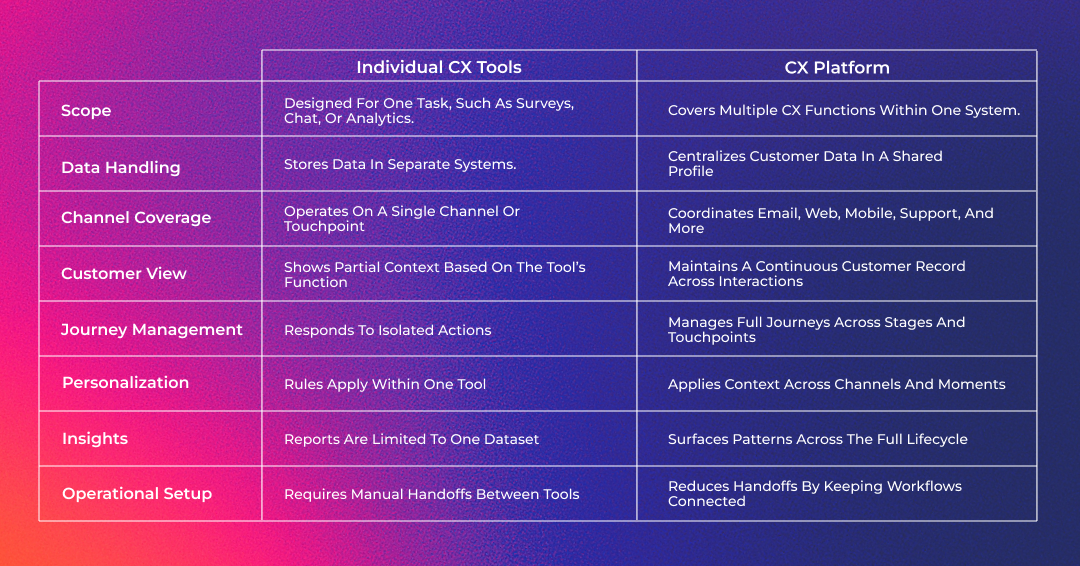
Customer experience platforms shouldn't be confused with tools to just manage customer conversations. They connect every touchpoint, give support teams context, and help businesses resolve issues faster.
Customers reach out through phone, chat, SMS, web, and mobile. A CXP coordinates all these channels so conversations flow without interruption. This means your live agent sees the full history when a customer starts a chat on your website and follows up by phone. They don't need to ask the same questions or start over.
This coordination eliminates drop-offs. Customers don't get stuck when they switch channels. Your team doesn't waste time asking for information that customers already provided. Hence, reduced frustration and better outcomes for everyone.
Every interaction generates data. A customer experience platform centralizes all this information into unified profiles. So when a customer calls, your live agent or chatbot will have instant access to their complete history, including preferences, past purchases and issues, sentiment scores, etc.
This context changes everything. Agents don't ask customers to repeat themselves. Chatbots reference previous purchases to suggest relevant products. These profiles turn disconnected interactions into coherent conversations.
AI identifies what customers need before they have to ask. It analyzes all your data sources to highlight patterns such as what a customer bought, what they browsed, and what problems they've encountered. The system then creates recommendations based on that analysis.
A caller with a history of requesting specialized assistance will be automatically routed to the most experienced agent. Someone browsing a service repeatedly over the past week can be encouraged to hit subscribe by offering them a discount.
This type of proactive automation drives personalized support while reducing the workload of your agents by handling their routine tasks. Your customers don't only get faster resolutions, but also tailored solutions.
A CX platform tracks call drivers, performance trends, and customer sentiment across all channels. You see what's driving calls, who's performing well, and where processes are breaking down.
Predictive signals take this further. The system flags customers at risk of churning based on behavior patterns. It identifies conversations likely to escalate. These insights let you act before problems grow.
Customers would rather handle their issues on their own. The CX platform meets this need by providing self-service functionality. The platform manages virtual assistants, smart IVR routes, and other AI capabilities that can resolve common queries without the need for human intervention. Customers are then able to access their order status or receive answers from the knowledge base without the call being transferred to a live agent.
Such automation reduces cost while improving customer experience because virtual agents are available online all the time, running 24/7, so you can scale up as you grow. You're not stuck in a perpetual hiring and training cycle.
CRM systems, customer data platforms, call center software, and enterprise apps all contain data. A customer experience platform connects these systems through prebuilt connectors and APIs so that information flows between them automatically.
CX solution partners like Mosaicx fit into existing ecosystems without forcing you to replace what works. Your data stays synchronized and your teams access what they need without jumping between tools. This integration eliminates silos that slow response times and create inconsistent experiences.
Businesses can easily scale their CXP during peak seasons without sacrificing performance. That includes handling millions of interactions without service disruption, adding new channels as needed, and adapting to business growth.
Customer experience platforms also comply with federal and industry rules. They protect customer data through encryption and security protocols, while also complying with other regulations to avoid costly fines.
In healthcare, for example, a CXP becomes highly valuable as it can handle patient spikes during flu season, keep PHI safe, and comply with HIPAA to build trust.
Organizations that use a CX platform see shorter resolution times, more personalized service, and stronger customer relationships. These lead to higher customer satisfaction scores, fewer churn rates, and compounding ROI.
You can't expect customers to think about channels. They'll reach out the way they think is most convenient. Someone may send a message on your social media account and then continue the conversation through email before finally calling the office.
Without a customer experience platform, your live agents are never going to see the full customer journey. They'll waste time asking the same questions multiple times because of the missing context.
A CXP eliminates these disconnects by centralizing customer information. When a customer moves from one channel to another, the context moves with them. Your team sees previous conversations, purchase history, and preferences immediately.
Generic interactions don't work anymore, but delivering personalized support to millions of customers is a tall ask. That's where a CXP comes in. The platform uses customer data to personalize interactions at scale automatically.
When a customer reaches out for support, live agents can see what products they own, their previous complaints, and what solutions worked for them in the past. All of this eliminates any guesswork about what marketing messages to send out based on past actions of those consumers.
Remember that your customers can always tell the difference between a generic response and a solution that’s customized just for them. Personalized responses boost satisfaction and strengthen loyalty. Such customers stay with your business the longest, becoming your highest revenue sources as they spend more on products and services over their lifetime.
Every interaction generates data that lives in a different system based on the journey's touchpoint. Contact details belong in a CRM. Support tickets may have their own separate ticketing system. Call recordings are usually done live in the contact center. This fragmentation creates several blind spots, especially for your sales team. Nobody has a complete view of the customer journey.
A CXP solves this by pulling data from all systems into one unified view. Teams work from the same information and everyone can see the full picture. Hence, decisions become smarter, service improves, and opportunities start revealing themselves.
Customers are now more demanding than ever. They expect support outside business hours and want answers fast. These expectations can't be fulfilled at scale without automation.
A CXP allows an organization to use AI-powered chatbots that handle common queries around the clock. They also use the same knowledge base that your agents use, so they are both helpful and reliable.
Now, you might be wondering why an organization needs a CXP for virtual agents. Why not have separate AI systems? The key difference is that these AI features work more effectively when integrated into a customer experience platform, as they leverage unified customer data.
An AI agent that can see purchase history, past interactions, and current issues provides better help than one working with limited information.
The access to unified data also gives you predictive capabilities. The system alerts your teams to potential problems before customers notice them.
Customers leave when your team fails to deliver quality support. Every bit of friction pushes them closer to a competitor. However, when service feels helpful and personal, customers have no reason to look elsewhere. They stick around longer, spend more, and even become brand ambassadors by recommending you to others.
With a CX platform, your support structure, which previously existed as a necessary expense, becomes an engine for growth.
It also uses analytics to prove the positive ROI of any CX investment. Hence, your leadership gets clear visibility into how service impacts retention, lifetime value, and revenue.
Traditional tools can't coordinate with each other. They don't share data, so teams end up manually copying information between systems or asking customers to repeat themselves.
Volume compounds these limitations. As customer interactions increase across more channels, traditional tools buckle under the complexity. Response times slow down and customer satisfaction drops.
A customer experience platform addresses these limitations by design. It's built to handle multichannel volume, personalize at scale, and automate intelligently. Organizations that stick with disconnected legacy tools find themselves unable to meet modern customer expectations.
Every CX platform is not meant to be the perfect fit for your business. You need to closely evaluate your business needs and vendor options when comparing platforms.
AI capabilities are allowing organizations to achieve higher customer satisfaction scores across the board. The difference shows up in how quickly customer problems get solved and how well customers feel understood. This operational efficiency has made AI a fundamental necessity of the modern business world that aims for enhanced customer experience.
AI is best used to empower your live agents instead of replacing them. Traditional chatbots have become a lot smarter through machine learning and conversational AI. These virtual agents don't just resolve the day-to-day customer queries; they do so with great accuracy and speed. This frees agents to focus on complex issues that require human judgment.
Your business gets to deliver faster response times and personalized support without burning out your staff.
The problem with waiting for customers to report a problem is that they're already frustrated from experiencing the issue. AI-powered predictive analytics flip this dynamic.
The CX platform analyzes patterns in customer behavior, usage data, and historical interactions to identify potential issues before customers notice them.
A basic example would be an automated security check if there’s unusual account activity. The customer would appreciate this rather than being told after fraud has occurred.
Now let’s consider a more complex vertical. There’s a customer who has been considering upgrading their subscription package for weeks. Your customer data proves this by showing their browsing history.
It’s also possible that their product usage patterns signal confusion. Rather than waiting for them, your sales team can reach out first with helpful guidance and even add a discount to sweeten the exchange. Chances are that this proactive service helps the customer move forward with confidence.
This shift from reactive to proactive service changes how customers perceive your brand. Your CX platform becomes a tool for preventing problems instead of just fixing them.
Customers want answers immediately. They don't want to navigate phone trees, wait in chat queues, or search through help articles using exact keyword matches.
NLP makes self-service actually useful. Customers can type or ask questions in their own words and get accurate answers. You don't even have to be specific because the AI understands intent. It's not following a rigid script that only triggers on specific keywords. Just asking "Why was I charged twice?" beats having to search for "duplicate billing" in the knowledge base.
These systems improve over time. Each interaction teaches the AI more about how customers phrase questions and what answers work best.
CX platforms with strong NLP capabilities deliver self-service that feels as helpful as talking to your most experienced live agent. The difference is that self-service is available 24/7 across every channel.
Mosaicx does more than just automate your customer interactions. We offer an AI-powered platform that adjusts in real time to intent, language, and sentiment. Your CX starts to feel genuinely responsive and human instead of disconnected and scripted.
Engage is our conversational AI solution for fully automated yet human-like interactions. Its intelligent virtual agents resolve your daily customer inquiries without any human oversight.
Our IVAs detect tone, sentiment, and language to autonomously carry forward every interaction with clarity and purpose. It’s not automation for its own sake. Every exchange is engineered to feel human and complete.
Pair that with Insights360 to see the full picture. Every interaction becomes usable insight, showing you exactly what’s working, where customers get stuck, and how experiences perform from first touch to final resolution.
If you’re ready to move past disconnected CX tools, request a demo and see how Mosaicx helps you connect, engage, and learn from every conversation.

Conversational AI is rapidly becoming a critical tool for businesses of all sizes. It can help businesses improve customer service, increase sales,...

One of the most common pain points for any customer service business is the cost of unanswered calls. You not only frustrate your customers who might...
.png)
Modern contact centers operate in a fundamentally different environment than before. There's a long line of customers coming through multiple...