
 Mosaicx
How to Build, Train, Test, and Deploy Conversational AI Solutions in 2026
Conversational AI is rapidly becoming a critical tool for businesses of all sizes. It can help businesses improve customer service, increase sales,...

How you support customers now has a very real effect on your bottom line. That’s the core of customer experience and ROI. When customers get quick answers and don’t have to struggle to explain their issue, they leave happier, and that happiness shows up in your financial returns. AI simply makes the connection easier to capture by reducing the cost of routine interactions and improving retention.
When people talk about CX ROI, they’re basically asking one thing: If we put time or money into improving how customers interact with our business, what benefits do we actually get back? It’s a way of connecting metrics like happier customers, repeat business, and smoother operations to real revenue gains and cost savings.
CX ROI = (Net Profit From CX Initiative – Initiative Cost) / Initiative Cost × 100
Let's see how that actually works by taking a real-world example.
Imagine rolling out a new chatbot, and the entire project costs you $50,000. Over the next year, support calls decrease enough to save you approximately $75,000, and in addition, you generate an extra $45,000 because more customers complete their purchases. Altogether, that’s $120,000 in benefits.
Now plug that into the formula, and you’ll see that your business achieved a 140% gain from that initial $50K investment.
CX ROI is now an important and rather common topic in boardrooms. Most businesses compete primarily on customer experiences, but with billions at stake, executives want proof that investing a certain amount of money and resources will actually yield a return. There's no room for any guesswork.
In 2024 alone, an estimated $3.7 trillion in global sales were put at risk because of poor customer experience. This means that organizations that get their CX right now are set to grow faster and keep more customers.
What's changed is that AI tools make it easier to prove ROI. Take conversation analytics. These platforms use AI and NLP to analyze customer conversations, showing how specific issues connect to churn or lost revenue.
When you can show that fixing a specific complaint reduces churn by an X percentage, or that improving a process saves Y hours per week, you're speaking the language of finance teams. The connection between CX actions and business outcomes becomes trackable. Showing the math also means you get their trust.
CFOs are never interested in vanity metrics. Those "feel-good" ratings and sentiment scores are just not enough. What really matters to them is how customer experience directly translates into financial outcomes. The metrics below are what your finance team really cares about.
Platforms like Mosaicx combine all these metrics into one AI-driven solution. Their conversational AI automates routine interactions, while a built-in analytics tracks customers at every stage of their journey.
This paints a full picture that shows exactly where costs spike, containment drops, and which interactions lead to churn, retention, or venue.
You gain the much-needed content to make informed decisions that actually improve ROI instead of guessing which CX investments will pay off.
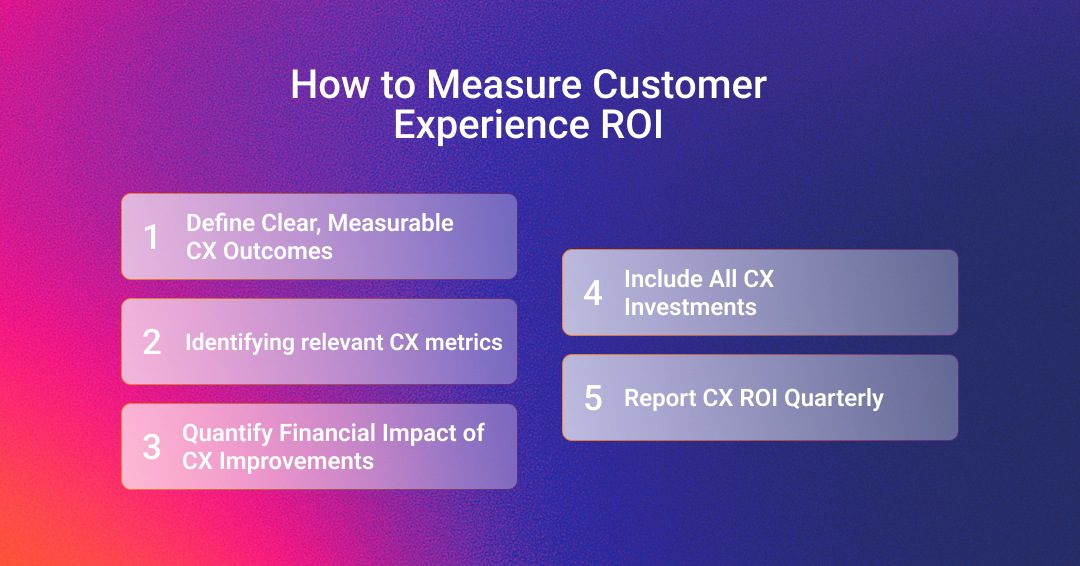
Calculating your CX returns takes a bit more than just plugging numbers into a formula. You need a clear framework that shows exactly how your customer experience drives financial impact.
Start by setting specific goals that actually mean something for your business metrics. However, pick one outcome per initiative based on what matters most. If you're looking to improve your support chat, maybe you'd want to reduce call volumes or handling time. Don't try to measure everything at once.
Now pick the metrics that relate to your goals. There are only two rules to follow here. The metrics should relate to revenue, and your systems should be able to track them. That's how you gain accurate ROI.
You then turn those metrics into dollar values. Use these simple formulas to calculate ROI.
Retention: Multiply the customers retained by what they spend annually.
Example: Keep 500 more customers who each spend $2,000 yearly. That's $1,000,000.
Containment: (Increase in containment rate) x (Total interactions) x (Cost per call - Cost per contained interaction)
Example: Shifting 10% of 100,000 calls to chat ends up saving $90,000.
FCR: (FCR improvement %) x (Total contacts) x (Cost per contact)
Example: Improve FCR by 5% on 50,000 monthly contacts at $15 each. That's 2,500 fewer contacts monthly, saving $37,500.
CLV: (Average purchase value) x (Purchase frequency) x (Customer lifespan)
Example: Customers usually stay 3 years and spend $500 annually. You extend that to 4 years. That's $500 extra per customer.
Make sure you list every cost that went into improving your customer experience. Leaving things out might make your ROI look better on paper, but it won’t give you an honest picture of how your CX is performing.
Some CX investments to remember:
CX ROI isn’t something you calculate once and forget. Build a quarterly review into your routine so you can see what’s working, spot issues early, and share solid numbers with your leadership that you can stand behind.
Modern analytics platforms can automate most of this. You don't need perfect data to start. Use what you have now and improve your process each quarter.
Your CX strategies pay off faster with AI and automation. They cut your service expenses, keep more customers around, and open up new revenue doors.
Automated interactions run cheaper than live support. Businesses that shift routine work to AI see their service budgets drop while maintaining the same high-level quality.
Chatbots and virtual agents handle common customer questions, while your human agents spend time where it counts. They're not reading the same password reset script for the tenth time today. They're solving real problems that require their human judgment and expertise.
Customers want quick responses and quicker resolutions. AI delivers just that, 24/7. There are no wait times or transfers to another agent or department.
They can call about their order status in the middle of the night, and have a virtual agent give them an exact ETA.
When your customers get help fast and feel heard, they’re far less likely to go looking elsewhere.
AI spots sales opportunities during service calls. If a customer asks about a feature, the system suggests an upgrade that matches their usage. If someone needs help with setup, it recommends products that pair well with what they bought.
The key is timing. AI knows when customers are open to suggestions based on their behavior and conversation context. These are relevant recommendations, not random upselling. This grows lifetime value without being pushy.
Businesses can expect to see their AI and automation returns within months, not years. The lower costs plus better efficiency result in faster payback. You also save money immediately on every automated interaction. Meanwhile, human agents handle higher-value work that moves the business forward.
Mosaicx's clients see fast ROI through structured implementation. They start by automating high-volume interactions, proving value before expanding to more complex use cases. This approach reduces risk and builds momentum.
Most CX teams struggle to prove ROI because they’re tracking everything except the numbers that actually matter. Important costs slip through the cracks, and the data they do have doesn’t connect back to the business. Here's what most businesses do wrong when measuring CX ROI:
What if every customer interaction could be used to drive your business forward? Mosaicx makes that possible. We help your operations work smarter, not harder, by turning everyday interactions into measurable impact.
Mosaicx Engage is our conversational AI engine built for scale. Its intelligent virtual agents (IVAs) are not your average chatbots. They understand context, detect sentiment, and respond in natural, human-like language.
Engage automates high-volume tasks like payments, account updates, and service routing, freeing your team for more strategic work while reducing costs, shortening call volumes, and delivering a seamless, always-on customer experience.
It works best when paired with Insights360, our built-in analytics platform, to uncover patterns and opportunities hidden in every conversation, at every touchpoint. This means smarter automation, more personalized service, and measurable ROI that grows with each interaction.
Interested in seeing it in action? Schedule a demo today and discover how Mosaicx can turn your business into a true competitive advantage.

Conversational AI is rapidly becoming a critical tool for businesses of all sizes. It can help businesses improve customer service, increase sales,...

One of the most common pain points for any customer service business is the cost of unanswered calls. You not only frustrate your customers who might...
.png)
Modern contact centers operate in a fundamentally different environment than before. There's a long line of customers coming through multiple...