
 Mosaicx
How to Build, Train, Test, and Deploy Conversational AI Solutions in 2026
Conversational AI is rapidly becoming a critical tool for businesses of all sizes. It can help businesses improve customer service, increase sales,...

Businesses are competing more on customer experience than on product or price. That shift makes sense when you consider that 86% of customers were willing to pay more for a great experience in 2025.
However, delivering a consistent CX is a challenge in itself. The customers of today demand instant answers and personalized interactions. They expect you to proactively solve their problems. Digital transformation is what makes all of this possible. It ensures your teams always have the right data and tools to resolve issues quickly and accurately.
In this article, we’ll show how digital transformation actually shapes customer experience, where it shows up in real interactions, what impact it has on the business, and a practical roadmap for getting started without overcomplicating the process.
Companies that invest in digital transformation aren't just buying software. They're changing how customers interact with their business at every step.
Think about checking your bank balance. You can do it from your app, send a text, get an instant update from a chatbot, or walk into a branch and have the teller see your full history. That's quality CX that stays consistent regardless of how you choose to interact.
This shift is only possible through smart systems that connect the dots between different channels. Data moves across platforms within seconds to deliver fast and personalized resolutions. Your customers spend less effort getting what they want. Automation and digital tools make your agents more efficient at their jobs. This is what digital CX transformation delivers when done right.
Customer engagement is all about having the right context to make every interaction count. Someone who contacts your support team shouldn’t have to repeat themselves. They expect you to already have the necessary information.
Digital transformation makes this happen. It ensures that the agent can see past conversations, purchases, and previous issues on a single screen. That's instant context the agent can use to resolve the problem instead of suggesting generic troubleshooting steps that might not work for every customer.
That same context changes the relationship beyond support. Businesses can spot needs earlier and respond before small issues turn into real problems.
Digital transformation also makes engagement more interactive at every stage. Customers can track orders, update preferences, and give feedback on their own time. They don't have to wait for business hours or handoffs.
The technology handles timing and delivery, but relevance is what creates impact. A fitness app that sends generic “stay active” messages gets ignored. One that notices you’ve skipped workouts for a few days and suggests a quick routine gets attention. The difference is knowing what the customer needs right now.
This approach works across the entire lifecycle. New customers get onboarding that matches their experience level. Active users receive guidance based on what they haven’t explored yet. At-risk customers see outreach tied to where they dropped off.
Customers notice when companies respond quickly. The gap between customer behavior and business action shrinks, trust grows, and engagement feels earned instead of forced.
The impact of digital transformation on CX shows up in every daily interaction. Customers move between websites, stores, and support channels without thinking twice. They expect each interaction to work without friction. Here's how businesses make that happen.
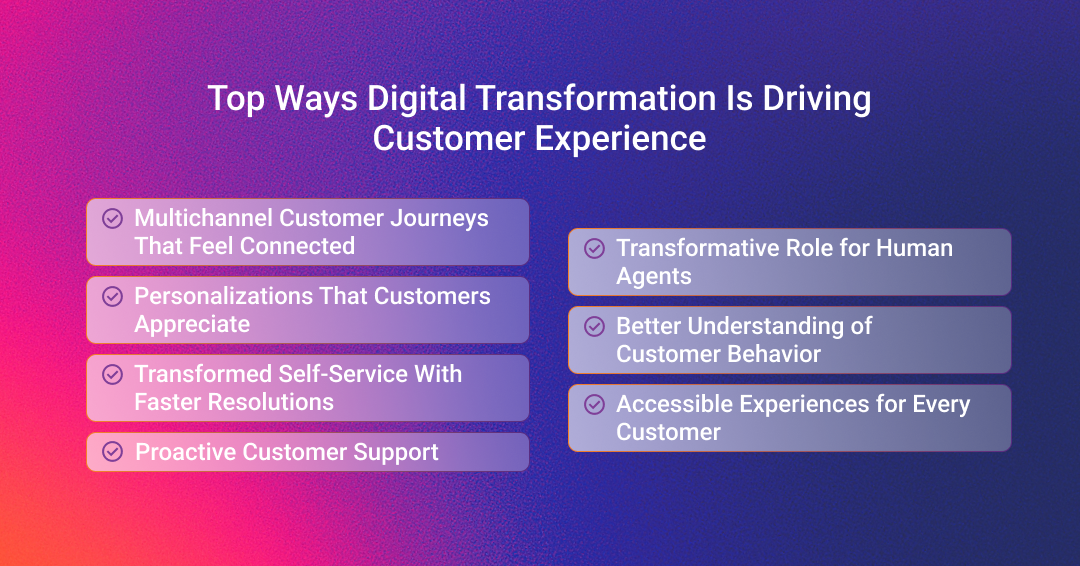
Someone uses your live chat for support and then moves on to email before asking for an update on the phone. They don't have to repeat themselves. Every agent who gets involved already knows the context because all systems share information across channels. This is what a multichannel support looks like in practice. It empowers customers to reach out as they want while still getting accurate help.
Real personalization isn’t limited to just remembering names. It means using data to make things easier. A returning customer might log in and see products based on past purchases. The website skips irrelevant options and shows what fits their needs. This improves your business messaging. The customer feels their needs are being understood.
Personalization also extends to support. Someone with a history of detailed troubleshooting guides doesn't have to mention it every time. Your agent knows their preference and will offer to send a detailed email for their convenience.
75% of customers admit being more likely to buy from a company that knows their purchase history and recommends products based on past purchases. This impacts both customer satisfaction and loyalty over time.
Customers prefer finding solutions on their own. Digital transformation plays a role here by making self-service easier. Customers no longer have to dig through FAQs for irrelevant answers. They can now access digital portals where chatbots pull the right troubleshooting guides or helpful video tutorials within seconds.
Most companies have invested in updating their websites and stores with more intuitive features. Their knowledge bases are now highly organized with search algorithms that quickly find relevant content based on keywords, while still having clear options to reach a live agent within seconds.
Today's customers are highly demanding. They expect issues to be resolved before affecting them. Someone whose flight just got delayed will appreciate it if your system sends them an automated text before they leave for the airport. A quick reminder for subscription renewal means that the customer doesn't have to jump through hoops to update their payment info at the last minute.
Every company faces issues but proactive support helps prevent the resulting frustration. It’s one of the clearest ways your support team can stand out from the competition.
Automation defines how digital transformation is impacting customer experience. The system handles all your routine customer questions while your live agents spend their energy on complex problems.
Automated systems tie in with several use cases we've mentioned above. They pull relevant information from knowledge bases during live calls. They make sure your agents have all the context they need when a customer calls for an update.
Consider someone who contacts support about a delayed product. They're clearly frustrated. Instead of asking them for their order number, the agent immediately moves the conversation to a resolution. This is because they already know the order details and shipping timeline from the system.
Digital transformation also impacts customer engagement by showing you where they are getting stuck. Your system data reveals when customers abandon their carts on the shipping page or exit the app after seeing the price. It's also how brands identify specific product features that are the cause of the most support calls.
A retail store might notice that most customers add items to their cart but leave without buying. A review points towards unexpected shipping costs. So the store adds a shipping calculator with clear cost breakdowns right in the cart to help reduce drop-offs before they happen.
This example clearly highlights the importance of understanding your customer journeys. It’s how businesses improve CX instead of guessing.
Every customer has different needs. Some prefer phone calls. Others want their problems solved through chat. Some prefer larger text or screen readers. They all deserve the same quality of service. But this is only possible when your systems are designed with your customers in mind.
Accessibility features like language options and flexible authentication are a major part of digital transformation. They remove barriers instead of creating them.
For example, a bank that simplifies its app navigation and adds voice support helps more customers complete tasks on their own. This reduces call volume while improving satisfaction for everyone.
Your investment in digital transformation pays off in multiple ways. You experience better retention and higher revenue growth on average.
Most people engage with a company based on the quality of customer service they receive. Investing in CX turns that trust into real results, making you 10-15% more likely to grow your revenue.
Better CX also reduces the cost to serve each customer because every contact you prevent saves money. Self-service ensures that customers have fewer reasons to call. Chatbots are especially effective here. They resolve matters in minutes that would normally take a live agent maybe 10-15 minutes.
That means more customers move through your pipeline without adding support costs. It’s why self-service and live chat are set to surpass traditional channels by 2027.
One smooth experience isn't enough. You need to consistently deliver great customer experiences to build loyalty. This is important because existing customers are your highest-earning sources. They spend the most because they're not going to your competitors. They also forgive occasional mistakes and recommend you to others. So your investment in CX directly impacts customer acquisition as well.
Consider a subscription service that handles billing issues on the first call. They proactively credit accounts and follow up to confirm everything works. Their customers stay subscribed for three years and also bring two of their friends, who further bring in theirs.
Connected systems reduce a lot of wasted work. Your data moves between departments without manual entry. That means inquiries get routed to the right person on the first attempt while automation takes care of tasks that don't need human judgment.
Here’s what that looks like in real life: a customer emails support but that message lands in a general inbox. Someone has to manually assign it to the right team. Then the team reads the email, checks the account, gathers the needed info, and finally responds days later.
Digital transformation ensures the same email is recognized instantly. The system identifies the issue and customer details, routes it to a specialist with complete context. As a result, a response goes out within hours instead of days.
Customers compare experiences, not just products. Consider two insurance providers who offer similar coverage and rates. One has an app that handles claims in minutes. The other requires phone calls and paperwork. The choice is obvious for customers deciding between the two providers.
The stats also make it clear. 73% of consumers considered customer experience an important factor in their purchasing decisions in 2025. Speed and reliability become the deciding factors when everything else is equal.
Agents have more energy when they stop spending time on mundane tasks. That means they perform better and feel more confident in their work. They also stay longer because they're not burning themselves out every single day.
Digital tools help by removing your agents' daily friction. A single integrated platform makes the same work feel smoother and keeps agents engaged and motivated. On the other hand, a support team forced to switch between five disconnected systems won’t have the energy to give each customer the care they deserve.
Technology matters. But it's not the whole story. CX digital transformation fails when companies buy software and expect immediate results. The real work happens around the technology, not inside it.
Customers move from marketing to sales to support and expect everyone to know what's happening. That requires shared goals across teams. Your marketing needs to know about your support interactions. Sales needs visibility into onboarding issues and support needs context from the purchase process.
Clear ownership prevents gaps. Each moment in the journey has a responsible team that can fix problems. This ensures that a customer doesn’t have to call three different departments for a single issue. That just means they are repeating themselves three times and increasing your resolution times.
Most companies don't realize that digitizing a broken process only creates more confusion. The wrong and inefficient steps only happen faster. Hence, you need to start by removing approval bottlenecks and clarifying unclear policies. The whole process should first work manually before you can bring in automation.
An insurance company might want to automate its claims processing. However, the current workflow includes 10 approval steps and unclear criteria that often lead to escalations. They need to first simplify their process, consolidate forms, eliminate duplicate approvals, and clarify decision criteria so agents can act independently. The company can now bring in automation to amplify a good, working process instead of scaling a bad one.
Good technology speeds up routine work and shows relevant information. It maintains continuity when customers switch channels and helps agents make better decisions faster.
Consider a retail customer who contacts support about a delayed order. The system shows the agent the customer's order history, current shipping status, and three similar cases from the past week. The agent sees that those cases were resolved by upgrading shipping at no charge.
This gives the agent context immediately. They can make an informed decision without escalating and the customer gets help in one interaction. Technology didn't replace the agent in this example. It made the agent more effective.
Digital transformation requires continuous adjustment based on what you learn. Track key moments in the journey and monitor where customers struggle. Review escalations for patterns and use feedback to spot problems early.
A banking app's new check deposit feature might show that 30% of users never finished their deposit. Reviewing their full journey sessions may reveal that they were getting stuck on the photo quality step. The instructions weren't clear enough.
The bank can simplify the language with visual examples and see the completion rate jump for the next round of users. Without measurement, the bank would have celebrated the launch of its new feature and missed the problem.
Digital transformation for customer engagement needs a clear roadmap from the start.
Start with the customer journey. Document every major touchpoint where customers interact and document what they try to accomplish there.
Then find the pain points. This can be long wait times, confusing navigation or simply unclear or missing information. Remember that each friction point is an opportunity.
Additionally, define success clearly so you know if your systems are working as intended. Pick metrics that matter like first contact resolution rate and average resolution time.
Remember that implementing new technology isn't success. Using that tech to increase your FCR is.
Some issues frustrate customers. Others affect a large number of people. The best approach is to start with problems that do both.
Consider an online retailer that's facing a complicated checkout, unclear shipping information, and slow support responses. Checkout affects every order. Shipping questions drive 40% of tickets. Improving response time would require hiring more agents.
They can't fix everything at once so the retailer starts with shipping. It's high volume and easy to improve. Adding a shipping calculator and tracking updates reduces support tickets. Then they tackle checkout with fresh momentum.
Get leadership support early by showing them the business case. Seeing the importance of reduced costs and competitive advantage will make your CX transformation a priority instead of an initiative.
Next, get teams aligned on what success actually looks like. Shared goals matter more than individual metrics. All departments need to be on a single page about what outcomes they’re working toward.
Then remove ambiguity. Define who owns each part of the work and how conflicts get resolved. This ensures that teams don’t stall waiting for answers.
That clarity is what keeps momentum going. Instead of debates slowing things down, leaders step in quickly, teams stay focused, and work moves forward without friction.
Evaluate options based on outcomes instead of features. Can it handle your full customer journey across channels? Does it integrate with existing systems? Will it scale as you grow?
Make sure to test your system with real scenarios. Run a pilot with actual customer interactions and see how the tech performs under normal conditions.
Remember that this isn’t just a software purchase. It’s a partnership. What's their implementation process? How do they handle problems? What does ongoing support look like? Ask these questions without holding back.
But don't fall into the perfect solution trap. Endless evaluations only waste time. Something good enough to start beats perfect every day.
Launching a system and its features all at once is risky. It opens you up to multiple problems at every end, which severely disrupts your service. A phased rollout lowers the risk.
You should always begin with a pilot. Choose one channel, use case, or customer segment. This gives you a controlled environment to test your system and uncover gaps.
Then measure the outcomes. Does the system work as intended? Are customers getting stuck somewhere? Make adjustments as needed before expanding to another channel and use case.
For example, a healthcare provider rolling out a patient portal might start with appointment scheduling at just two clinics. That first phase exposes technical issues and gives staff time to get comfortable.
In phase two, they add prescription refills and extend the portal to five clinics. In phase three, they include lab results and roll it out system-wide.
Each phase builds confidence. Problems surface early when they’re easier to fix. Teams adapt without feeling overwhelmed and patients ease into the change instead of being forced to adjust overnight.
New systems often fail because your staff is expected to adjust their work without enough support. They need comprehensive training that mirrors real work.
Create playbooks and reference guides that walk them through specific situations and how your new tools make the process easier.
Take a call center rolling out new routing technology. Instead of just demoing the software, they run agents through practical scenarios. This gives them context about what to do when the system suggests the wrong department or when to override routing.
They also create quickguides for the most common situations and keep them within reach at every desk. This results in higher agent confidence and technology that actually delivers value because the staff knows how to use it.
The real work starts after your system launches. You need to continuously track performance and review metrics to spot patterns. Your new system has all the data. It's your job to spot emerging issues before they become major problems.
Escalations happen. The important thing here is to learn from them. Find out what went wrong. Maybe an agent needs more training, or there's missing information. Use those insights to tighten your workflows and improve the system. Then bring training and policies back into alignment so they reflect how the work is actually getting done.
The most common example here is a company that launches an AI chatbot. Monitoring weekly conversation logs reveals that the bot struggles with return policy questions. Customers have to repeatedly ask for clarification.
The team discovers that it's because their current policy language is too complex. They rewrite it with more clarity and update the chatbot's knowledge base. Without constant monitoring, the chatbot would have continued to impact customer satisfaction rates.
A few core technologies are changing how businesses interact with customers. None of them works alone but each does something specific that makes the digital transformation of customer experience possible.
Let's start with data platforms. These pull customer information from every system into one place. When a support agent opens a customer profile, they see everything. The customer doesn't have to explain that they already called twice or that they bought the product last month. The context is already there.
Then there's automation that takes care of routine tasks. A customer can reset their password at midnight and get back in immediately. Questions like "Where's my order?" get answered by a chatbot in seconds. However, don't take this as a call to replace your staff. Automation is about empowering your agents to do their jobs more effectively.
AI makes systems smarter over time. The system reads a support ticket and routes it to the person who has solved that exact issue before. It watches an agent struggle with a tricky case and suggests three solutions based on what worked last week. The more cases the AI processes, the better the system gets at predicting what comes next.
Analytics show what's working and what isn't. A business can spot where its new automation workflow is slowing down. Without analytics, they'd never know where the problem was. With it, they can measure whether the fix actually helped.
Integrations tie everything together. When a customer updates their address in one system, it updates everywhere. A refund processed in the payment tool shows up in the order history and triggers an email confirmation. No one has to manually sync data between platforms or ask customers for the same information twice.
These technologies only help when they make the customer's life easier. A fancy AI chatbot that can't solve basic problems wastes time. A data platform that doesn't share information with support agents misses the point. The best tech disappears into the background and just makes things work the way customers expect them to.
The proof of better customer experience is in fewer escalations, faster resolutions, and smoother handoffs. Mosaicx helps you create that reality by blending automation with empowered support so your customers move through the journey with less friction.
Engage uses conversational AI to handle routine requests through intelligent virtual agents. Our IVAs are smart enough to understand context and respond in natural language. They can handle common tasks like updating account details, processing simple payments, and routing complex issues to the right agent day or night.
Engage pairs with Insights360 and Journey Insights to measure what’s happening in real time. Our analytics help you identify where conversations stall and pinpoint where process improvements matter most.
If you want to see how this works for your business, schedule a demo and we’ll walk you through the experience in action.

Conversational AI is rapidly becoming a critical tool for businesses of all sizes. It can help businesses improve customer service, increase sales,...

One of the most common pain points for any customer service business is the cost of unanswered calls. You not only frustrate your customers who might...
.png)
Modern contact centers operate in a fundamentally different environment than before. There's a long line of customers coming through multiple...