
 Mosaicx
How to Build, Train, Test, and Deploy Conversational AI Solutions in 2026
Conversational AI is rapidly becoming a critical tool for businesses of all sizes. It can help businesses improve customer service, increase sales,...
Chatbots and conversational AI are often paired together as the same type of technology. While they can be similar in some ways, they are quite different.
Chatbots are one of the simplest forms of automation. They rely on having clear user scenarios and pre-programmed responses. Sometimes chatbots are great with simpler interactions that do not require complex conversations and help users have a successful self-serve experience. Many times, however, they fall short. Regardless, they represent a massive global market that’s projected to hit about $30 billion by 2029.
Conversational AI works differently. It adapts in real time instead of sticking strictly to scripted flows. The system provides accurate and relevant answers because it has the ability to identify intent. That flexibility makes interactions feel more natural and less robotic.
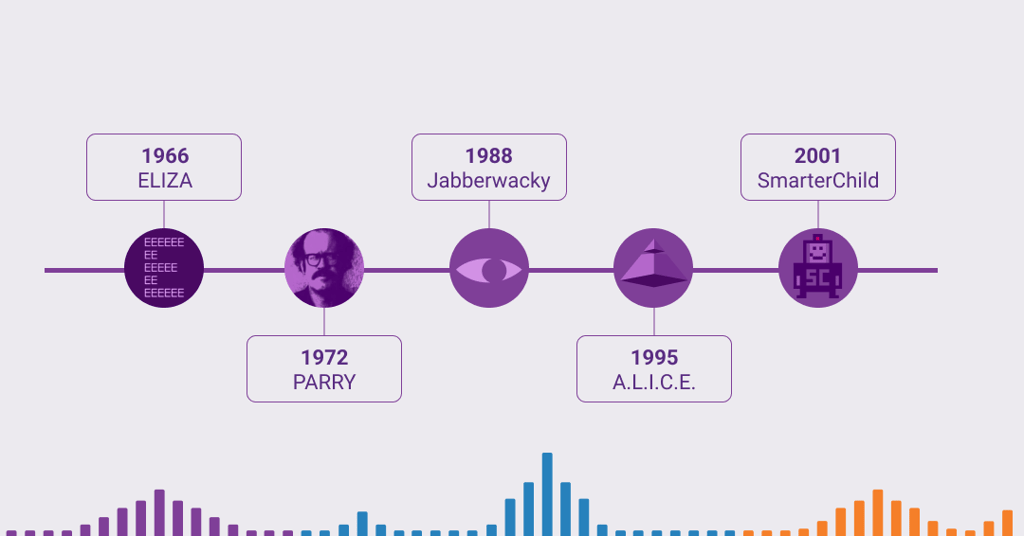
Chatbots are software programs designed to mimic human conversation through text. Their origins go back to the 1960s when ELIZA was developed to simulate a psychotherapist. Other chatbots such as PARRY in the 1970s, Jabberwacky in the 1980s, and ALICE in the early 1990s followed these initial efforts, and as we expected, their complexity and conversational abilities improved. By the early 2000’s, an even more advanced chatbot called SmarterChild was created, and since then, they have become more and more common.
Today, chances are you have interacted with Apple's Siri, Google Assistant, and Amazon's Alexa, which have started to incorporate AI but remain still pretty fairly basic in comparison with advanced conversational AI options in the market.
To put it in simpler terms, chatbots are rule-based systems that help customers accomplish something.
Banking Chatbot: Customers get empowered to complete simple tasks like checking account balances and confirming transactions. Most of these bots follow predefined rules, interpreting user questions based on how they’ve been programmed and guiding customers through set conversational paths to deliver accurate answers.
Customer Service: Chatbots handle everyday customer service tasks like tracking orders, processing returns, and answering common questions every day. Just like in the banking scenario, they follow a predetermined set of rules to provide their answers to customers’ queries.
Conversational AI helps organizations provide better services by automating customer service. However, unlike chatbots that use rule trees and predetermined answers, conversational AI uses machine learning to provide answers that are more nuanced, require a much clearer understanding of user intent and can adapt and evolve instead of being limited by a predetermined set of answers. It can also operate in both text and voice channels.
Conversational AI really came about in the 21st century, with virtual assistants like Siri, Google Assistant, and Amazon's Alexa. These assistants used NLP and machine learning technologies to identify what was being said and what would be the most accurate answer for that particular query.
More advanced conversational AI options that adapt directly to business cases have also been developed, such as Mosaicx, helping businesses provide natural-sounding solutions via conversational AI to user queries.
Technology Assistants: Technology devices that use conversational AI have slowly become part of our lives. Finding a home without some conversational AI tech device to help them turn on the lights, play their favorite songs, or set timers is rare.
The line between chatbots and conversational AI is a bit blurry. Some companies position themselves as conversational AI providers even though they really build rule-based chatbots. However, at an essential level, chatbots are mostly and primarily rule-based technologies that do not have the capacity to act beyond those boundaries while conversational AI is a much richer and robust option.
Some similar features are:
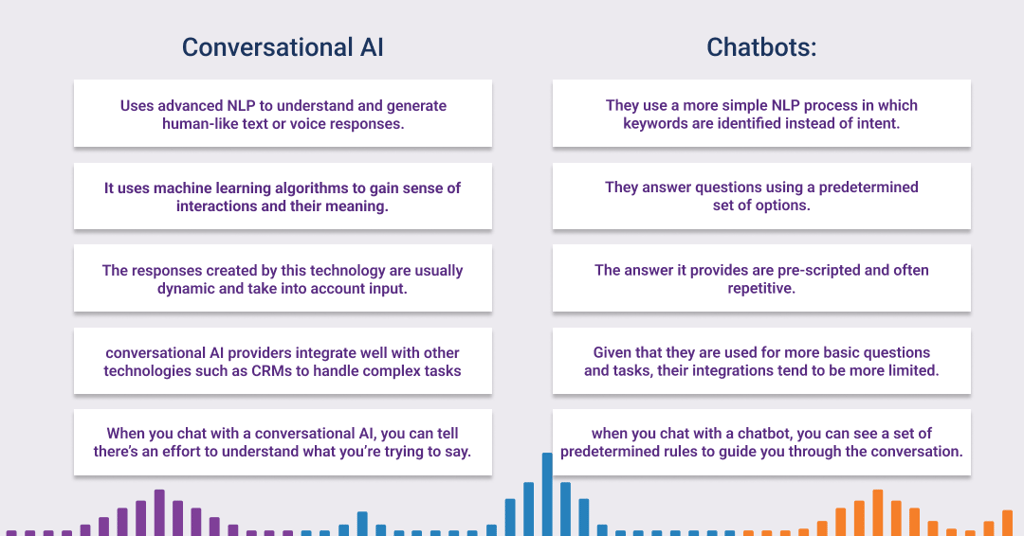
The core distinction is complexity. Both handle customer interactions but they operate at very different levels. A chatbot follows rules. Conversational AI understands context. Here's a side-by-side look before we break each difference down.
|
Chatbots |
Conversational AI |
|
|
NLP |
Matches keywords only |
Identifies intent and context |
|
Machine Learning |
Rarely used |
Core to how it works |
|
Response Quality |
Scripted and repetitive |
Dynamic and context-driven |
|
Integrations |
Limited |
CRMs and complex systems |
|
User Experience |
Rigid |
Fluid |
Conversational AI uses advanced NLP to understand and generate human-like responses. This is the biggest difference between the two. A traditional chatbot looks for specific keywords to return a preset response. Conversational AI understands users even if they phrase the same question differently. It reads nuance and keeps context across the entire conversation. Users often have no idea they're speaking with a virtual agent.
Most basic chatbots don't use machine learning at all. They work off a fixed decision tree where they always respond X if a customer says Y. Conversational AI is entirely based on machine learning. This enables the system to actually learn from every interaction to become smarter over time. A resolution that a user marked as somewhat satisfactory will be improved the next time until the AI delivers clear satisfaction.
A chatbot's responses are written in advance. Every possible answer already exists in its script before a single customer shows up. If a question falls outside what's been pre-written, the response either fails or loops back to something irrelevant. Conversational AI works differently. It generates answers based on actual input and conversation history, so responses feel relevant rather than recycled.
Chatbots have limited integrations by design. They don't need much on the backend because they are meant for simple, contained tasks. Conversational AI, however, works best when it's connected with your existing systems. This allows the system to pull information from CRMs and other management platforms as needed without human oversight.
The difference between chatbots and conversational AI here matters for complex queries. Someone may call to ask about an order and then want a refund. Conversational AI here can address both queries within the same interaction by pulling the relevant information from different systems.
Chatbots rely on a set of predetermined options. If an issue isn't included in the flow, users become stuck or sent back to the start of the loop. Conversational AI identifies what a user is actually trying to accomplish, even if they word it differently each time. Every response is based on that intent to ensure the system meets them where they are.
An excellent way to think about what solution is right for your organization is to step into your end-user's shoes. Would they be able to solve most of their questions and problems by having a virtual assistant with a predetermined set of options? If the answer is yes, then a chatbot would suffice. This is often true for service scenarios where most issues are quickly resolved or relatively common.
On the other hand, if the user of your service or product has a more complex interaction with your brand and may require a context-ready virtual assistant to get the help it needs, conversational AI technologies will almost always beat chatbots.
Mosaicx is an AI-powered customer service platform that enables organizations to create intelligent virtual agents (IVAs) to solve user queries. With our conversational AI technology, you can efficiently and accurately resolve customer inquiries with a tool that identifies intent and adapts based on context to provide the best solution possible.
On top of that, we constantly innovate and learn more about AI, ML, and predictive intent technologies and other combinatorial technologies that help our partners improve the service quality provided.
We’re confident our conversational AI solutions are the best choice for enterprise businesses looking to scale and improve customer experience and customer support. Schedule a free demo right now and discover how Mosaicx helps.
Q: Is ChatGPT a Conversational AI?
Yes, ChatGPT is a conversational AI provider. Their team is more focused on research and startup-scale implementation. If you need a more robust and experienced partner for your enterprise, options like Mosaicx are better.
Q: Is Conversational AI Expensive?
Like most technological products today, the price range varies. However, a conversational AI partner will likely be more expensive than a chatbot solution because it has a more complex technological backend and more advanced features. But it also provides a higher ROI, so it’s usually the smarter financial choice.
Q: Can a Chatbot Use AI?
Yes. Even basic chatbots can use some form of AI to understand questions better and provide smarter answers.
Q: Which is better for customer support: chatbot or conversational AI?
It depends on the complexity of your needs. A regular chatbot works fine for simple FAQs. But you'll need conversational AI to handle nuanced questions and pull live data to manage multiple requests in one conversation.

Conversational AI is rapidly becoming a critical tool for businesses of all sizes. It can help businesses improve customer service, increase sales,...

One of the most common pain points for any customer service business is the cost of unanswered calls. You not only frustrate your customers who might...
.png)
Modern contact centers operate in a fundamentally different environment than before. There's a long line of customers coming through multiple...