
 Mosaicx
How to Build, Train, Test, and Deploy Conversational AI Solutions in 2026
Conversational AI is rapidly becoming a critical tool for businesses of all sizes. It can help businesses improve customer service, increase sales,...
.png)
The gap between what customers want and what companies provide keeps widening, mostly because support teams are operating blind. Customer experience analytics changes that. It gives you the clarity to see where customers are struggling and why.
You no longer have to guess or experiment with random operational changes. CX analytics gives you a clear roadmap, helping your teams make improvements and decisions that directly impact satisfaction, retention, and revenue.
Customer experience analytics refers to a process of collecting and analyzing data from customer interactions to understand how customers are using your product, how they see your service, and where they are struggling.
The goal in every instance is to point out friction points for your team to immediately address. Every fix, even small changes, add up to improve customer experiences, leading to higher satisfaction scores.
This, however, differs from general customer data analysis, which only tells you why something has happened. It doesn't have the same context as CX analytics. For instance, a general analysis might only show a 40% call abandonment rate, but CX analytics will tell you why. In this case, they might be getting stuck at a specific hand-off.
For modern businesses, customer experience drives revenue and growth. Here's why analytics to improve customer experience matters for your business right now:
Customers expect more. Even those who have been with you for years will consider alternatives after one bad interaction. Depending on the industry, many customers will even pay extra for better experiences. CX analytics helps you keep your customers happy by catching problems before they become churn.
CX separates you from competitors. Every company collects feedback but very few act upon it. Leveraging data to solve existing pain points distinguishes you. It proves that you care for your customers.
You save time and money. Your analytics data points your team in the right direction. You know exactly what needs to be fixed and why. It beats using guesswork to waste precious resources on changes that don't matter in the long run.
Ignoring CX data costs you. If you're not worried about your customer's experience, you'll soon lose them to someone who is. Retaining customers is always cheaper than attracting new ones.
Revenue grows when CX improves. Higher satisfaction rates drive cross-sell rates. Long-term customers are your highest earners as they use more services over their lifetime and also bring referrals.
It all begins by collecting data from anywhere your customers connect and processing that data into something meaningful that you can act on. It’s at this point that you can see what’s working well and what’s not, and act based on that information.
Your CX data comes from various sources like voice calls, live chat sessions, surveys, IVR interactions, etc. Every channel captures different pieces of the customer experience.
Having multichannel visibility gives you the complete picture of the customer journey. You're no longer missing context just because someone switched channels. A customer frustrated on chat yesterday might call today, and without unified data, live agents start from zero again.
CX analytics brings together both structured and unstructured data. You’re not just seeing metrics and numbers, you’re seeing what happened and why.
Raw data is messy. Voice calls need transcription, chats contain typos, and different systems label the same issue differently. AI and automation clean up your data without any human involvement, so your team can quickly address the matter.
Most modern businesses are pairing that automated cleanup process with sentiment analysis to read the emotion behind customer words. The system catches frustration in phrasing or word choice that might be otherwise overlooked.
There are also intent detection algorithms that go further, identifying what customers actually want even when they don't state it directly. It's how you get reliable insights instead of inconsistent data.
CX analytics surfaces what you couldn't see before. You might discover that 60% of dissatisfied calls stem from four common issues, or that certain agents resolve tickets faster because they use a different approach. The more CX interactions you analyze, the more patterns you start seeing.
This is where data becomes valuable. You move from guessing where customers might be struggling, such as during checkout, to having proof of why the checkout process needs to be fixed. Insight discovery separates companies that collect data from companies that actually improve.
Analytics for customer experience fuels continuous improvement. Once you know some agents are struggling with specific call types, you move in to train them specifically for those scenarios. That's the difference between knowing problems exist and actually fixing them.
Teams use these insights to optimize everything from clunky self-service menus to rigid chatbots. Each cycle of measurement and adjustment makes experiences smoother.
The analytics data you collect should change how your team interacts with customers. It should be used to improve your systems. Here's how businesses turn analytics into tangible improvements across six key areas.
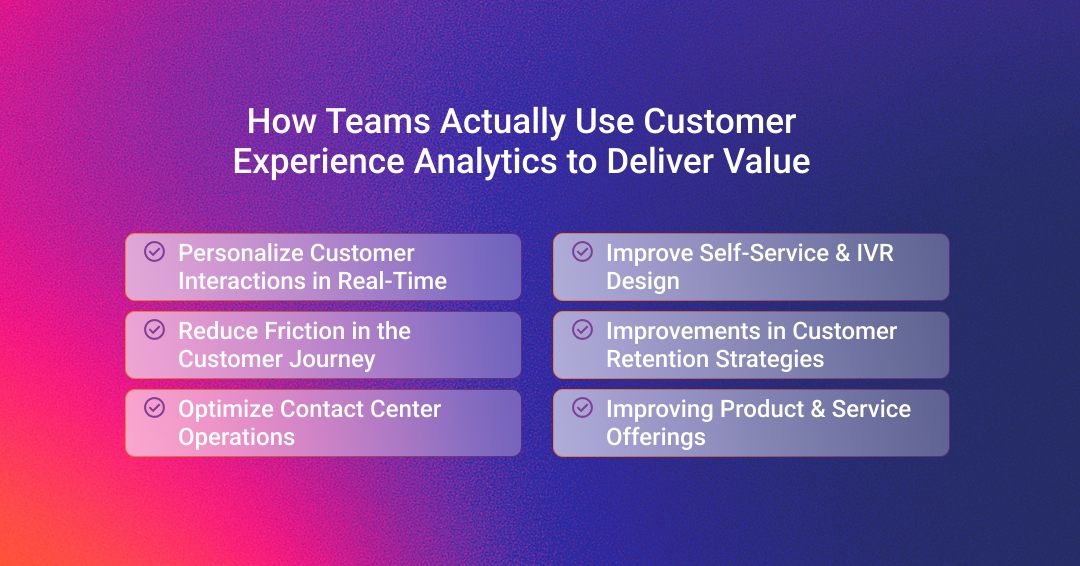
CX analytics pulls data from multiple sources, allowing your live agents to see the customer's complete history, sentiment, and intent before responding. They can then adjust their approach immediately, skipping basic questions and moving straight to fast resolutions in case of a frustrated customer.
Proactive support takes this further. When data shows a customer struggling with onboarding, you can trigger targeted guidance before they reach out. These moments of personalization reduce effort and build trust.
Analytics show exactly where your customers are struggling, so that your team can quickly move in to remove these friction points.
Most often, CX improvements come down to removing unnecessary steps that add no value. Shorter survey forms see more participants. Similarly, shorter troubleshooting instructions give more clarity. Your data will tell you where exactly customer experience is dropping.
Note that friction exists across channels, not just one. A customer might start on your website, continue in your app, then call support. If each channel requires re-authentication or repeating information, you've built friction into the journey. Analytics reveals these cross-channel pain points so you can fix them.
CX analytics make it easier for contact centers to improve their operations across teams/departments. The data helps predict call volumes to improve staffing and address the problem of overstaffing. You know when to have the right number of agents during peak hours.
The same data also makes routing smarter. Calls can be matched to the most appropriate agent based on the issue, sentiment, language, or history. This drives higher customer satisfaction instead of randomly assigning calls.
Most importantly, CX analytics play an important role in coaching. You know exactly which agents resolve issues the fastest and how. These techniques can then be used by managers to coach other agents who are struggling with the same call types.
Customers who abandon your IVR and request an agent signal a design problem. CX analytics shows you where they exit, which menu options confuse them, and what they're trying to accomplish. You can then restructure flows to match actual customer needs.
This is important because successful self-service reduces costs and improves satisfaction. When customers solve problems without waiting for an agent, they save time and you save resources.
Churn indicators appear in your data before customers leave. This can be in the form of a drop in product usage, an increase in support contacts, negative sentiment in recent interactions, or longer gaps between purchases.
Customer experience analytics automatically surfaces these patterns. When analytics flags an at-risk customer, your team can proactively reach out before they decide to leave.
Provide personalized solutions based on their usage patterns and address their problems quickly while the relationship is still salvageable.
Feedback isn't just the surveys you sent. Customers asking the same questions or abandoning workflows at the same points is their way of telling you what needs to be fixed. CX analytics aggregates these signals across thousands of interactions so patterns become clear.
If 30% of support calls mention confusing navigation, redesign navigation. If customers consistently request the same integration, build it.
The data also opens doors for innovation. You might discover that customers use a feature in unexpected ways, suggesting new use cases. Most businesses often find that a segment of users would pay more for capabilities they're currently piecing together through workarounds.
These insights come from analyzing behavior patterns across your customer base, not from individual feature requests.
The right metrics help you spot friction, measure loyalty, and track how satisfied people are at each stage. Here are the top CX metrics that matter.
Customer experience analytics promises clarity, but many companies struggle to turn data into real insight. Here’s what’s keeping them back:
Customer interactions are bound to be scattered across different channels. If these channels are not feeding into a single source, your CX analytics will only show fragments instead of the full picture.
Multichannel communication lets you track the complete customer journey instead of isolated moments, which hide key information from live agents. Build integrations that automatically pull interactions from every channel without manual transfers.
Your analytics dashboard keeps generating reports to highlight problems. However, your team spends too much time identifying what needs fixing first and how. By then, you have already amassed hundreds of complaints for the same reason.
This is more common than you think. The solution is a system that analyzes customer interactions in real time. It should track sentiments as they change during live calls and flag specific phrases that signal frustration or confusion.
The system should then automatically prioritize the issues by volume and impact, so your teams know exactly where to focus their improvements.
Legacy systems aren't fit for modern business requirements. It demands too many resources for manual quality reviews. Your teams work in isolation, having no idea about the other customer conversations passing through their department. This leads to training gaps as well as key feedback getting lost.
Your CX analytics tools can't help here unless you use automated systems. AI can automatically evaluate every voice call, chat, and message for quality, compliance, sentiment, and more at scale. This gives you a large dataset that catches emerging issues with higher accuracy.
Your customers expect personalized experiences. Most organizations are aware of customer preferences, buying behavior, and previous grievances but are unable to get their live customer support staff fast enough access to this information during a live conversation. Thus, they are forced to rely on generic customer support responses, leaving loyal customers frustrated when they've spent years doing business with an organization.
AI is once again the smart solution to this problem. Use it as an assistance tool to empower your live agents. AI surfaces relevant customer history, suggests next-best actions based on context, and automates routine tasks so agents focus on complex problems.
Customer experience analytics should can then show which automation handles what types of requests best, so you can continuously refine your approach.
Mosaicx enables contact centers to turn customer insights into actionable improvements across every interaction and every channel. We have the tools you need to have a bird's eye view of your entire operations, as well as the complete customer journey.
You're not investing in a solution for just more reports. You're getting clarity into where customer experiences are breaking down and why.
Mosaicx's Engage uses conversational AI-driven virtual agents to automatically handle payments, verify eligibility, manage transactions, and resolve service requests through natural, human-like conversations. Your customers get immediate help without their call ever reaching a live agent.
We also offer Insights360 to give you complete visibility into every interaction across all channels. It's our end-to-end analytics platform that tracks sentiment in real-time. You identify friction points as they emerge and understand exactly which issues drive repeat contacts and which resolutions build loyalty.
Journey Insights adds another layer by digging into your IVA interactions to show the paths customers take, where automation succeeds or where it hits a wall. This helps optimize the digital journey while keeping human interactions just as smart and efficient.
Mosaicx's Dashboard puts the metrics that matter in front of the right people at the right time. No more digging through reports to find what's actionable. See performance trends, spot outliers, and measure the impact of every improvement you make.
With Mosaicx as a partner, your CX analytics are no longer reporting exercises. Instead, you use the data to automate and personalize to improve customer experience and satisfaction. Schedule a demo today and see how analytics-driven automation transforms customer experiences.

Conversational AI is rapidly becoming a critical tool for businesses of all sizes. It can help businesses improve customer service, increase sales,...

One of the most common pain points for any customer service business is the cost of unanswered calls. You not only frustrate your customers who might...
.png)
Modern contact centers operate in a fundamentally different environment than before. There's a long line of customers coming through multiple...