
 Mosaicx
How to Build, Train, Test, and Deploy Conversational AI Solutions in 2026
Conversational AI is rapidly becoming a critical tool for businesses of all sizes. It can help businesses improve customer service, increase sales,...

Generic marketing doesn’t work anymore because your customers don’t move in straight lines. They'll browse product comparisons on their mobile, send an email for information, and shop on their desktop. Every interaction leaves a clue that points to what they want next. AI-driven customer journey personalization connects those dots based on customer preferences and needs in real time. This ensures that the experience keeps up with the customer instead of restarting every time.
Personalization reduces friction. Customers complete purchases faster when they already see the products and content they need. Time isn't wasted in browsing entire catalogs or digging through layers of pages. Customers are also most likely to return because the experience feels effortless.
The key is making them feel understood. Three common pain points highlight why this matters:
First, customers abandon journeys when they can't find what they need. A shopper looking for winter jackets shouldn't see swimwear recommendations. Poor relevance wastes their time and yours.
Second, customers distrust brands that ignore their history. Someone who bought a laptop last week doesn't want laptop ads today. They want accessories, software, or setup guides. Ignoring context damages credibility.
Third, customers leave when experiences feel disconnected. They browse on mobile but add items to their cart on desktop. Receiving an email that doesn't account for that switch means treating them like a new visitor.
Traditional personalization uses rigid rules that may work for simple scenarios but break down quickly when adapting to complex customer behaviors. A simple rule to show fitness gear when someone clicks on sports items can feel relevant in the moment, but it falls apart once the customer’s behavior becomes less predictable.
AI customer journey tools process behavior signals differently. They analyze dozens of factors like what a customer browses and for how long, where they click, which items they add to their cart, what marketing emails they open and ignore.
Machine learning models pick up on these patterns across channels. A customer who views pricing twice in 48 hours, stalls at checkout, and reopens a product email shows different intent than someone who browses casually once.
This level of accuracy is simply impossible with a human team, especially for enterprise businesses with thousands of products and even more customers.
It’s also just not pattern detection. AI also brings predictive models that calculate the likelihood someone will purchase, abandon, or need support based on their current behavior. This enables the system to take the next best action for each customer. Hence, the journey experience feels intuitive rather than scripted.
Personalizing customer journeys with AI follows five steps. This flow repeats throughout every customer interaction.
Consider a customer who opens their bank’s mobile app late at night to check a charge. But they also explore a few pages about personal loans without starting an application. The system notes a pattern. That the customer often hesitates after browsing personal loans.
The next time the customer visits the banking website, they’re shown a clear comparison of loan options and estimated payments instead of generic content. They explore again and leave.
That pause triggers the next step. The system sends an email with a pre-qualified rate and a short application, removing uncertainty rather than adding pressure. The customer applies this time and gets approved.
Success! The AI logs this win as a correct sequence of actions it can use to guide future customers that show similar patterns.
Most businesses try to automate everything in sight when building personalized journeys. This approach usually leads to shallow or unnecessary implementations that only frustrate customers while draining resources.
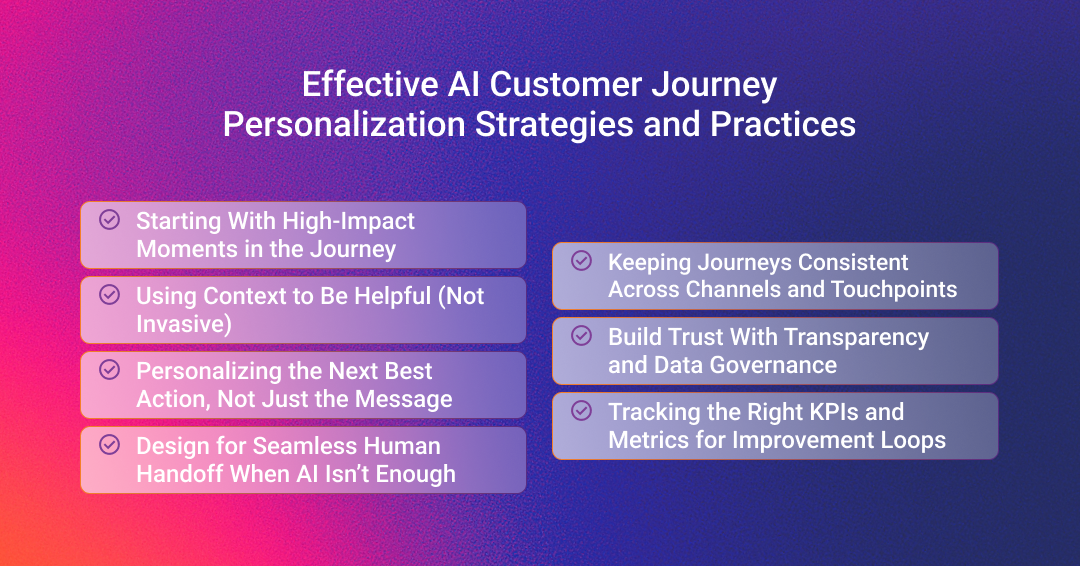
Pick one or two journey points where customers often get stuck or drop off. These moments might seem small but they deliver the biggest returns when you fix them.
A SaaS company might notice a large volume of trial users who never complete onboarding. AI reviews their data and identifies that users are getting stuck on the second setup step. The company then makes targeted improvements instead of guessing. It adds personalized video tutorials specific to each user’s industry. This gives clarity and confidence, reducing the abandonment rate in the coming months.
Personalization only works when it feels helpful and relevant. It usually comes down to context that’s based on customer data like what they are browsing or what they've purchased recently. This is also data that customers expect you to have and use to make their journeys better. Problems start when you surface information that feels more like surveillance than service.
Take retail as an example. It’s reasonable for someone browsing running shoes to see socks or performance gear later. That kind of personalization follows their intent and feels useful. But if the same store greets them by name after a single anonymous visit, the tone changes. What felt helpful suddenly feels unsettling.
Hence, transparency is critical. You should be open about what data you're collecting and why. It's equally important to let customers set their own preferences. This makes relevance something they opt into themselves instead of being forced on them.
Remembering names or rewording messages isn’t personalization. A customer only feels the experience is built for them when you help them take their next step. It’s about reducing their effort.
AI uses behavior patterns to anticipate needs and clear the path forward. A banking app may notice users who view mortgage rates but never apply online. The bank identifies the friction point and uses AI to route these users to a phone consultation instead of another form. The human element gives them the confidence to move forward, increasing completion rates.
Your AI needs to recognize its limits. That means setting clear triggers for when a case should be routed to a human agent instead of trapping customers in an endless loop of unhelpful responses.
Modern AI models can spot these moments. They use sentiment analysis to detect emotional cues like frustration and anger. Escalation becomes the best next step in these cases.
For example, a customer might try to dispute a bank fee through chat. The chatbot explains the policy but the customer keeps pushing back. Instead of running around the bank's policies, the system routes the conversation to a support agent who can review the account and respond with context.
Most customers simply want to speak to a person because it feels more personal. Designing for an easy handoff respects that preference.
Customers move between web, chat, email, and phone without thinking. Your systems need to do the same.
Someone who adds an item to a cart on mobile should see that item appear when they log in on desktop. If they start a support chat on the website for the item and later call, the agent shouldn't ask them to repeat their case.
BSH Group unified dozens of touchpoints into a single customer view. This lets their support team send messages based on actual browsing behavior, no matter which channel the customer uses. If someone abandons a product on a page, the follow-up email can reference that exact item and answer common questions about it. This tailored approach helped boost their add-to-cart conversion rate significantly.
Every personalized customer journey depends on trust. Every customer should know why you’re asking for their information and that they have the power to control how their data is used.
Good governance, however, goes beyond basic data protection. It involves continuously monitoring AI to ensure the system is following your rules. Review decisions to spot possible bias due to poor training data. It’s common for algorithms to make mistakes. You just need to know when it does and fix it.
This oversight enables customers to trust your system. That's when they actually start to engage.
Measure metrics that are tied to outcomes and ignore the ones related to just activity. KPIs like conversion and activation rates are critical. Monitor resolution time and repeat contact rates as well. Watch customer satisfaction and retention scores.
Each metric shows how your customer journey experiences are faring. Don’t make the mistake of only focusing on cost reductions. The goal is to create better experiences, which then drive business results.
Take Netflix. 80% of all viewing is based on AI recommendations. That's a clear outcome metric tied directly to engagement and retention.
AI customer journey systems deliver value at every stage when applied correctly. Here are real examples of what works.
Buyers need information at the start of their journey instead of sales pressure. AI helps them find what they need faster by understanding their intent and context.
Dynamic Yield adjusts website layouts in real time based on visitor behavior. First-time visitors might see educational content. Repeat visitors might see product comparisons. The experience adapts without manual intervention.
Buyers compare options at this stage to find confidence that they’re making the right choice.
Adobe Sensei analyzes customer preferences and serves tailored product comparisons. If someone has been comparing two software plans, the AI highlights the specific features that differ between them and shows which plan fits their browsing pattern.
Salesforce Einstein scores leads based on propensity to purchase. High-intent leads see simplified paths to demos. Lower-intent leads get nurture sequences with educational content. The system removes confusion by matching the experience to readiness.
Any friction at this point usually kills conversions. Acowebs, for example, reduced their cart abandonment by showing estimated shipping fees earlier than later. Their customers appreciated having a clearer sense of the total price.
AI helps identify and fix these issues at scale. Digital stores can have their systems detect patterns where customers drop off and then personalize the journey in real time. This can mean highlighting relevant payment options or suggesting complementary products based on the items in the cart.
Beyond that, context-aware AI support helps reduce escalations as well. If someone is stuck on a form, the system can quickly trigger a proactive chat session to help them forward. Anticipating such needs makes the purchase experience feel relevant and reassuring.
The goal during onboarding is to help customers see value as quickly as possible. AI makes this easy by showing features customers are most likely to use instead of overwhelming them with the entire suite.
These personalized setups help improve retention. The system asks a couple of questions about how they want to use a product and automatically tailors the walkthrough. Users only see what's relevant and become productive faster.
Good support resolves issues quickly. Great support prevents them from happening again. Most contact centers rely on AI to generate personalized responses based on customer interactions. Resolution times drop because agents spend less time drafting and more time solving.
Predictive models are effective as well. They identify churn risk before it becomes obvious. Fewer logins, reduced engagement, product jumping— the system triggers outreach with relevant offers or check-ins.
A typical example comes from a subscription service that noticed users who missed two billing cycles rarely returned. Their AI system started sending a personalized retention offer after the first missed payment. It gave the users the option to pause their subscriptions instead of pushing a standard cancellation message. This small, timely adjustment helped more customers stay engaged and ultimately improved retention.
Personalization solely depends on the quality of data you feed your AI. Even the most sophisticated systems would only produce generic results without the right inputs.
You need four core categories of data to make personalization work.
Behavior signals show what customers actually do. The pages they visit, how long they stand, what they search for, and where they drop off all point to intent. This data tells you where someone is in their journey and what they care about right now.
Preferences are what customers tell you directly. Communication channel choices, product interests, notification settings, and stated goals give you permission to personalize in specific ways. This data builds trust because customers opted in.
History provides context. Purchase records, support interactions, past browsing sessions, and account tenure help AI understand patterns over time. A first-time visitor needs a different treatment than a loyal customer with five years of purchases.
Outcome feedback closes the loop. Conversion data, satisfaction scores, resolution rates, and retention metrics tell AI what's working. The system can’t improve without this feedback.
Above all, data quality matters more than volume. Clean, accurate data from fewer sources is always better than messy data from everywhere. This is also where you ensure that your systems are collecting data with purpose. If you can deliver a good experience with browsing behavior and stated preferences, don't ask for more.
Companies investing in AI personalization often sabotage their own efforts. Here are the mistakes that make personalization feel broken.
Why it hurts: Garbage data produces garbage personalization. Your systems give irrelevant or random recommendations that lead to broken experiences.
How to fix it: Standardize formats and remove duplicates. Connect your siloed systems to ensure all data is cleansed at once. Do all this before implementing AI.
Why it hurts: Nothing signals "we don't know you" faster than asking repeat customers to fill out forms with details you should already know.
How to fix it: You already have their data. Make the system populate the forms and use context from previous interactions to skip unnecessary questions.
Why it hurts: Shallow personalization everywhere delivers less value than deep personalization at critical moments.
How to fix it: Start with one or two high-impact touchpoints. Improve their personalized journeys before expanding.
Why it hurts: Customers get frustrated fast when they’re stuck in an AI messaging loop. They want to speak to an actual human but the system doesn’t know how.
How to fix it: Build visible escalation options. Ensure that the AI tells the customer firsthand that they can ask to talk to a human agent. Have clear CTAs that do the same.
Why it hurts: Personalized journeys backfire when AI guesses wrong but it still acts on it anyway. Irrelevant content and mismatched offers become the norm.
How to fix it: Set confidence thresholds. When AI isn't sure, default to neutral options or ask clarifying questions instead of guessing.
Why it hurts: High email open rates mean nothing if conversions drop. Similarly, lots of AI interactions don't matter if customers are less satisfied.
How to fix it: Track metrics tied to business results like conversion rates, retention, customer lifetime value, effort scores, and satisfaction.
Customers notice immediately when their support feels disconnected. They're forced to repeat themselves, switch contexts, and start over every time they move between channels. Mosaicx helps you avoid that by treating support as a continuous journey instead of a series of isolated interactions.
Engage, our conversational AI, uses intelligent virtual agents (IVAs) to keep conversations moving across voice, chat, text, and email without losing context. Our IVAs can understand customer intent in real time and know when to resolve an issue and when to escalate to a specialist. Your customers never feel the seams as they move across each touchpoint.
That activity then feeds into Insights360 and Journey Insights, our analytics duo solution. They show you which interactions are working and where friction is appearing. You can make immediate targeted improvements instead of relying on assumptions.
Everything comes together in the Mosaicx Dashboard. You can monitor and manage customer experiences without switching between different tools. Knowing which KPIs are performing at any given time gives you a clear picture of how customers are actually experiencing support.
Schedule a demo, and we’ll show you how we deliver more connected, measurable experiences across channels.

Conversational AI is rapidly becoming a critical tool for businesses of all sizes. It can help businesses improve customer service, increase sales,...

One of the most common pain points for any customer service business is the cost of unanswered calls. You not only frustrate your customers who might...
.png)
Modern contact centers operate in a fundamentally different environment than before. There's a long line of customers coming through multiple...