
 Mosaicx
How to Build, Train, Test, and Deploy Conversational AI Solutions in 2026
Conversational AI is rapidly becoming a critical tool for businesses of all sizes. It can help businesses improve customer service, increase sales,...

Your business interacts with customers across multiple channels. However, if these interactions are not connected, they prevent consistent service and personalization.
This is because your customer data becomes scattered across different systems, and that prevents achieving a full, accurate view of the customer journey.
This struggle with scattered systems is a major barrier to a good customer experience. The solution is a unified engagement platform (UEP). A UEP combines all communication channels and customer data into one system. It establishes the foundation for a unified customer experience.
If you want to improve your customer service to deliver consistent experiences across every touchpoint, this blog is for you. Here you will learn the advantages of a unified engagement platform and how UEP combines channels, data, automation, and AI to achieve desired outcomes.
Businesses are moving to unified engagement platforms to fix operational gaps that older customer experience setups create. Traditional CX tools sit in separate systems. They do not share information in real time, which limits how well teams can respond to customers.
Most businesses run multiple tools across marketing, sales, and support that store data in different places. Hence, support agents spend time moving between them, often switching hundreds of times per day. This slows down issue resolution because agents cannot see full customer histories or recent activities.
When agents spend extra minutes searching for data, the average handle time rises. More time per ticket raises the total cost of support. It also creates stressful workflows that reduce staff satisfaction. Businesses then spend more on hiring and training to fill the gaps.
Customer expectations continue to rise. Many customers want fast answers and consistent service from every department. Salesforce reports that 76 percent of customers expect this consistency. Yet 54 percent feel they still deal with disconnected teams. It’s because slow legacy systems limit how quickly businesses can respond, which affects retention.
Personalization works only when the data updates in real time. Unified platforms support this by bringing customer data into one view. Your agents and automated systems can immediately identify a customer and provide accurate recommendations.
Unified engagement also supports clearer measurement. Leaders can track customer operations, revenue impact, and retention from one source. This turns the contact center into a function that supports business performance with clear data.
Most customers choose voice when the problem is urgent or complex. Voice-led unified engagement follows this preference and treats phone interactions as the primary communication path:
Chat systems often struggle with emotional or high-pressure situations. Voice-led platforms handle these cases directly. They give customers a clear way to explain the issue and move toward a resolution. This builds confidence in the support process.
Intelligent Virtual Agents (IVAs) can handle whole calls on their own, instead of just sending customers to a queue like older systems. They use conversational AI to respond naturally, making interactions feel human and smooth. Hence, you get to reduce wait times, lower costs, and allow your agents to focus on tasks that require their human judgment.
Voice-led platforms use Natural Language Understanding. Customers can speak normally without having to deal with button menus or fixed scripts. The system automatically detects intent, dialect, and phrasing. This helps customers state their issue immediately in their own words without repeating themselves.
If a human agent is required, the system routes the call based on spoken intent. It sends the customer to someone trained for that specific issue. This improves First Contact Resolution compared with generic queue routing.
New voice AI tools already include models for banking, retail, and healthcare. They understand everyday terms and tasks, so teams do not spend a long time on setup. Businesses can put these systems to work in a few weeks instead of months.
A unified platform combines several support tools into a single system. This improves operational efficiency, data visibility, and service quality. Here are the operational and financial unified engagement platform benefits:
Customers want their problems resolved quickly. They don't appreciate delays or when they have to repeat themselves. Since a single engagement platform allows agents to immediately see customer profiles and knowledge bases, many issues are resolved on the first contact.
Wait times drop, and satisfaction levels improve. The reliable and consistent interactions also build trust over time, so customers are more likely to return and engage positively.
A strong multichannel engagement is necessary to maintain high customer retention. Switching channels often causes the customer to lose context. UEPs solve this by maintaining conversation history across all channels. This means a customer can start in chat and continue over the phone without repeating details.
The system recognizes the user and preserves context for the next interaction. This also enables asynchronous communication. Customers can pause a conversation and resume it later using another device. This continuity reduces frustration and prevents churn caused by disconnected service.
Support agents frequently switch between applications to access information. This raises the average handle time, increases errors, and adds stress.
UEPs combine CRM, ticketing, and communication tools into a single interface, reducing administrative tasks and letting agents fully focus on resolving customer issues.
Note that support teams are expensive to replace. With streamlined workflows making every interaction easier, your teams don't burn themselves out. They stay longer in their roles, which lowers your hiring and training costs.
Scattered data hinders analysis. When information from voice, chat, and email is stored separately, managers do not have a complete picture.
UEPs collect all customer data in one view. Managers can track KPIs across all channels. This allows for instant trend identification. For example, a sudden spike in complaints is detected immediately, alerting teams to respond quickly.
Unified data also supports better forecasting. Historical data helps predict call volumes and resource needs. Accurate scheduling results. This minimizes both idle time and overtime costs.
Traditional support doesn’t improve customer satisfaction because customers only reach out after a problem occurs. By that point, they’re already frustrated.
UEPs proactively use real-time data to detect and resolve issues before they affect a customer. For example, detecting a service outage or shipping delay within a system automatically informs the particular affected customer by SMS through a UEP.
The unified engagement platform benefits also include predictive routing. The system analyzes customer profiles and behaviors to route inquiries correctly.
Fixing issues early prevents escalation. This reduces wait times and improves overall efficiency.
Customers stay loyal when their problems are solved quickly. A UEP helps with this by giving agents full access to customer history and value. They can offer solutions that fit each customer. This builds stronger relationships, stabilizes revenue, and lowers the need to spend on acquiring new customers.
Live agent support is expensive. UEPs tackle that problem by integrating automation and self-service tools. Simple, common requests like password resets or order tracking are handled automatically. This keeps basic inquiries away from human agents, so they can focus on more complex issues that need their attention.
Teams often work separately. Support, sales, billing, and field teams may not see each other’s interactions with customers. This leads to conflicting information and slow problem resolution.
UEPs share customer context across the enterprise. Agents immediately see open billing issues or unresolved technical problems. This prevents tickets from getting lost and ensures accurate, traceable collaboration.
Unified data makes marketing more precise because it gives your sales team a complete view of customer interactions on a single screen. They can target customers ready for offers and skip those with unresolved issues.
A customer who recently had a positive support experience is more likely to respond to an upsell, while one with a problem shouldn’t be contacted.
This way, a unified customer engagement platform boosts campaign results and turns the contact center into a revenue driver.
Centralized enforcement prevents errors. Managing security across multiple systems increases risk. Each integration point is a vulnerability. UEPs centralize security protocols, identity management, and access controls.
This simplifies auditing. It ensures compliance with HIPAA, PCI DSS, and GDPR. All activity is logged in one audit trail.
Policy changes and encryption apply consistently across all channels. This reduces the risk of breaches. It protects enterprise data and simplifies reporting.
AI is the core tool inside a unified engagement platform. It drives automation, speed, and personalization. The system instantly processes large volumes of data, improving results for both customers and agents.
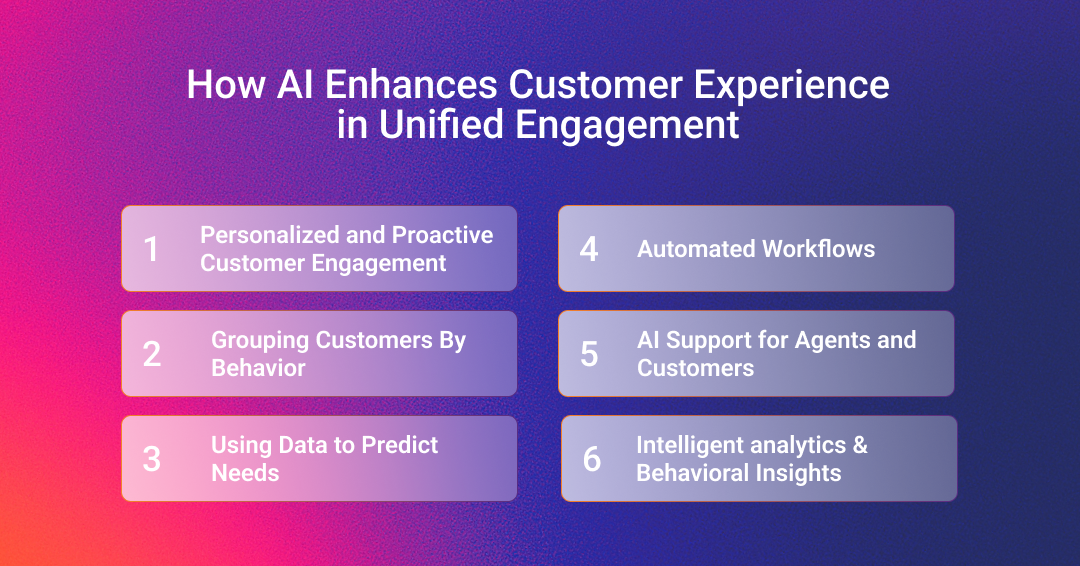
AI uses customer history and context to tailor every interaction. It knows what customers need before they ask, anticipating common issues. This moves support from reacting to problems to preventing them. This capability helps improve first contact resolution rates. Ultimately, this approach reduces the effort customers need to get help.
AI sorts customers based on what they want and prefer. These groups are updated in real-time, unlike static lists based only on past purchases.
This continuous analysis helps the system send the most relevant solutions instantly. It ensures the customer receives support that matches their current goal to maximize effectiveness.
Predictive analytics finds potential problems early. AI reviews thousands of usage patterns to spot signs of frustration or technical failure. If the system detects repeated struggle with a product function, it flags the user. This enables intervention before a complaint, preventing customer churn.
AI handles repetitive tasks like data entry and account lookups, reducing the burden of administrative work. This raises productivity and directly lowers average handle times and operational costs.
Virtual agents support human agents in real time by listening to conversations and suggesting relevant answers or policies. This reduces the need for manual searches and helps agents respond more accurately.
At the same time, virtual agents handle routine customer questions 24/7, improving the speed and consistency of service for both agents and customers.
AI checks customer language and tone (sentiment) during every interaction. It detects changes in mood or new complaints across the customer base. This data helps refine automation scripts and agent training.
Additionally, the system learns from every conversation to improve future service quality.
Your choice of a Unified Engagement Platform determines the efficiency of long-term support. There are various factors to consider while evaluating a UEP, including:
Voice is the primary channel for complex issues. Your chosen platform must prioritize voice capabilities. Choose a platform that offers AI-driven call containment. This feature handles entire transactions without human intervention.
The system uses Natural Language Understanding to interpret intent. This avoids rigid menu trees. The platform must also support multi-turn conversations to manage interruptions naturally.
Your UEP must combine data from all channels into one customer profile. This includes voice, email, chat, and social interactions. Do not use systems that create new data silos.
Security capabilities are essential. Find a platform that centralizes user access and security. Make sure it meets standards like GDPR, HIPAA, and PCI-DSS.
The platform should also keep full audit logs of all activity and enforce data encryption. These features protect the company from legal risk.
The UEP must integrate with your existing systems. Choose a solution that provides the advantages of unified communications, including features like screen pops. These display customer details when a call connects. Also, check for automated data sync. This updates records across all systems instantly.
UEPs must handle volume spikes without failing. Check the system's ability to scale during peak seasons. It should support expansion into new languages and markets easily. Scaling ensures support grows with the business without costly infrastructure changes.
Operational visibility is critical. Choose a platform that offers real-time analytics and track KPIs such as First Contact Resolution and customer sentiment.
Look for predictive analytics to help prepare for volume trends and recurring product issues. This data allows support to operate strategically rather than reactively.
Complex implementations reduce return on investment. Prioritize platforms that offer pre-trained industry models and low-code configuration. Choose a solution that demonstrates value in weeks, not months.
Ask vendors for specific metrics on implementation timelines. Faster deployment leads to quicker operational savings.
Mosaicx gives you more than just another digital tool to add to your tech stack. We bring a voice-first, AI-native solution that unifies every customer interaction across all channels.
With Mosaicx Engage, our award-winning conversational AI platform, your customers experience human-like interactions whether they call, chat, or message.
Our advanced IVAs listen, understand, and act in real time. They verify information, process payments, handle requests, or resolve issues in a single natural exchange. It’s like giving your best agents the power to be faster, more accurate, and available 24/7.
Automated engagement cuts operating costs, reduces errors, and speeds up service, all while keeping customers happy and your team focused on high-value work.
Ready to make every customer conversation count? Schedule a demo today and discover how Mosaicx can boost your customer satisfaction levels.

Conversational AI is rapidly becoming a critical tool for businesses of all sizes. It can help businesses improve customer service, increase sales,...

One of the most common pain points for any customer service business is the cost of unanswered calls. You not only frustrate your customers who might...
.png)
Modern contact centers operate in a fundamentally different environment than before. There's a long line of customers coming through multiple...