
 Mosaicx
How to Build, Train, Test, and Deploy Conversational AI Solutions in 2026
Conversational AI is rapidly becoming a critical tool for businesses of all sizes. It can help businesses improve customer service, increase sales,...
Every customer has experienced the frustration of repeating the same issue to multiple agents. When they switch from web chat to phone support, they are then forced to restart the entire conversation. This happens because the service systems operate in isolation. Telephony, email, and chat systems do not share data. Agents cannot see the full customer history in one place. This lack of visibility creates inconsistent service and significantly reduces satisfaction.
A Customer Engagement Platform (CEP) provides a structural answer to this problem. It is a system designed to centralize all customer data and interaction tools. The CEP replaces the fragmented, separate solutions that cause inefficiency. Its first function is to create a single, unified view of the customer. All interaction history is stored in one profile.
Hence, the agent resolves the issue faster because of this immediate context. This delivers accurate service and restores customer confidence.
A customer engagement platform brings all channels into one place. Voice, SMS, email, web chat, social messages, and even CRM data appear in a single view. This gives agents context the moment a conversation starts. Routing also improves because it uses customer history and needs, not just agent availability.
A CEP usually includes tools such as shared inboxes, live chat, chatbots, knowledge bases, case routing, feedback tools, analytics, and AI features. These help teams deliver personalized and scalable customer support.
Resolution times become faster, and service quality is consistent across all communication channels. Operating costs also decrease because all teams use one system instead of multiple platforms.
Separate tools for calls, email, and chat do not share information in real time. When a customer switches channels, the context of the previous conversation disappears. This creates repeated explanations, slow responses, and uneven service quality. Modern customers expect a smooth service, so this gap affects overall satisfaction.
A CEP solves this problem by keeping every interaction in one place. It builds a single record for each customer. This keeps the conversation focused and reduces unnecessary back-and-forth. It also gives teams a reliable view of the customer journey.
This clarity supports retention. Companies with consistent cross-channel service keep more customers over time. Research from Bain & Company shows that a 5% increase in retention can raise profits by 25-95%. A CEP helps create this consistency by reducing effort for both the customer and the agent.
Customer engagement software also has a clear operational benefit. Without a unified system, agents switch screens many times per interaction. This adds minutes to simple tasks. A CEP reduces this friction. Lower handle times lead to lower support costs across the team.
The data inside the platform also gives leaders a more accurate view of performance. Metrics like First Contact Resolution and response times become easier to track. Trends such as repeat complaints or product issues show up earlier. This supports quicker decisions and steadier service quality.
The technology infrastructure for customer interaction relies on several specialized systems. We will now review how each platform functions within your customer relationship cycle.
Your CRM is a system for managing all of your company's interactions. Its objective is the optimization of your business relationships.
CRM technology tracks standardized interactions across your sales, service, and marketing departments. The system facilitates internal process alignment using data you can share.
A MAP addresses the initial phases of customer acquisition for your business. It supports relationship establishment with potential customers.
Teams use MAPs for the automation of repetitive marketing tasks. This includes managing your email deployment and lead scoring. The primary function is to nurture your leads to a conversion readiness state. The analytics also help you track campaign performance metrics.
A CDP is a software application for data aggregation. It compiles customer data collected from numerous sources for you. The CDP structures this collected data into a unified customer profile and manages data compliance and structuring for your organization.
Other systems, like your MAP or CEP, access this platform for profile consistency. In short, the CDP provides the required centralized data view.
A CEP addresses the post-sale phase of your customer lifecycle. Its function is personalized service delivery and retention.
The CEP centralizes your communication channels into one platform interface. It uses CDP data to support your loyalty programs and proactive service. These platforms are utilized to reduce customer attrition rates and increase satisfaction among your existing clients.
A CEP handles your communication and data needs. It combines functions previously handled by separate software. Its features control your efficiency and retention results.
Your CEP handles all communication channels. This includes voice, chat, email, and social media. The platform puts them into one system, giving your customers a consistent experience. It maintains context during transfers so that your customer does not have to repeat their issue.
Your CEP centralizes data from many sources, creating one full customer profile to remove data silos. The profile gives your agents the full history immediately. This reduces friction and speeds up issue resolution.
The platform uses data to personalize interactions. It guides your customers through specific journeys based on customer behavior and preferences. For example, if a customer abandons a cart, the system sends a targeted email. This makes your communications relevant.
AI improves engagement on several fronts. The technology utilizes chatbots that handle routine questions without requiring staff involvement. The system also supports smart routing, so inquiries are automatically directed to the most appropriate or available agent. You get a support platform that scales effortlessly while still feeling personal and responsive.
Your CEP provides you with real-time reports. These tools track important metrics across all channels, from FCR to sentiment scores. This data gives vital feedback that will help you perform at an optimal level and align your experiences with business objectives.
The ideal digital customer engagement platform is scalable. So, in peak seasons, you can add more chatbots, for example, to handle large volumes, and scale down afterwards to manage your costs.
Besides, security is paramount for each enterprise. CEPs fulfill standards such as GDPR, HIPAA, and PCI-DSS out of the box. This compliance keeps your data safe and avoids legal troubles.
Your CEP must work well with the systems you already use. Strong API and integration capabilities create that link. They connect the CEP with your CRM and ERP, so data moves across your stack without effort. This flow removes manual errors and keeps information consistent in every application.
Businesses use customer engagement platforms to organize customer interactions. They manage complex journeys based on customer actions. This ensures service is consistent and operations are efficient for your business.
CEPs start predefined onboarding processes right after account sign-ups. These flows use the most effective channel for the user, with content tailored to the user's activities.
For example, if a trial user views the 'Billing' page, the CEP automatically recognizes this event. It then sends an email detailing specific pricing plans.
This immediate, guided process ensures your user quickly understands the product value. It also reduces the risk of early abandonment.
CEPs detect when customers stop engaging. The platform finds customers at risk based on inactivity. It then triggers automated campaigns. These campaigns use offers or support to bring back customers.
Here’s a basic example: If your customer is inactive for 30 days, the CEP sends an SMS reminder with a discount code. This action improves your retention rate.
Global businesses use CEPs for consistent, local service. AI helps with translation and routing in real-time. For example, a customer typing in French goes directly to a French agent or gets automatically translated into a language that’s native to the agent. This ensures your customer reaches the right resource quickly.
CEPs use event-driven messaging. These messages are automated and contextual. Examples include purchase confirmations. If a user clicks 'Buy,' but the credit card fails, the CEP instantly sends a recovery email linked directly to the checkout page. This makes your communications highly relevant.
Conversational AI chatbots are excellent first responders, automatically handling routine requests like password resets so customers get answers right away.
It also knows when something needs a human touch, picking up on intent or urgency and escalating messages like “need to cancel” directly to a supervisor. This keeps agents focused on the moments that matter and helps customers get faster, more thoughtful support.
Your brand continues engagement even after a sale. CEPs deliver tailored content based on customer history. The platform identifies the best time for an upsell prompt. For instance, three months after buying a basic phone, the CEP sends an alert offering an extended warranty plan. This strategy maintains customer value.
Customer engagement platforms help your business notify users fast during service disruptions. If a server outage affects customers in one region, the CEP filters the contact list and sends an SMS alert only to customers in the affected area. This ensures timely information. It also manages customer expectations and prevents the support center from being overwhelmed.
Marketers use these platforms to manage complex campaigns. The CEP controls automated flows across email and SMS. If a customer ignores a marketing email, the system automatically schedules a follow-up SMS message reminding them of the offer. This coordinated approach maximizes reach.
A customer engagement platform acts as a central system for all external business communications. The platform unifies customer data and communication channels. This removes friction in business processes and results in measurable improvements in how you manage clients and use internal resources.
Customers expect service that is fast and competent. They should not have to repeat their issue. A CEP ensures every service agent instantly sees the customer's full history.
An agent can begin an interaction knowing the customer's last purchase or recent email. Hence, customers get what they want faster and without much effort, leading to high satisfaction scores.
The platform tracks behavior. This allows your business to anticipate needs, rather than just reacting to issues. You can identify accounts at risk of leaving early. This proactive approach builds loyalty, which is important because it’s generally more expensive to find new customers than to keep existing ones.
Separate data systems create information gaps. A CEP fixes this by putting all engagement data into one dashboard. This gives a factual view of your operations.
You can track popular channels, peak traffic times, and agent metrics like resolution time. This data allows you to make informed decisions about staffing and strategy.
Investment in engagement technology directly affects your bottom line. Reducing customer churn protects your recurring revenue. Additionally, agents can use purchase history to identify relevant up-selling and cross-selling opportunities.
A CEP also improves your ROI by combining technology. You manage one platform for multiple functions instead of paying for many single-purpose tools. This efficiency lowers your total cost of ownership.
Manual workflows waste employee time. Agents lose productivity when switching between systems or copying data. A CEP streamlines these workflows.
Automation handles routine tasks. This includes ticket routing or basic information requests without human input.
Your team can handle more work volume without added stress. This stabilizes your operational costs as the business expands.
Your brand's reputation depends on the quality of service you deliver. Inconsistent service on different channels reduces trust.
A CEP enforces standardization. It ensures that messaging and response times meet your company's quality standards on every channel.
So, a customer receives the same professional service whether they use text or call. This consistency strengthens your position in the market.
A good engagement platform adapts to your specific requirements. It does not force you to change your operations.
You can use APIs to connect the platform to your existing databases. The system scales with your team and your strategy. This flexibility ensures the technology continues to support your business goals over time.
A customer engagement platform works differently from a simple software solution. It supports your complete customer strategy, not just one task. You also get to manage large volumes of interactions as your business grows.
A simple software collects data only from its own channel. A standalone chat tool, for example, only records the chat transcript. This data remains siloed, or separate.
A CEP aggregates data from all communication channels. The system collects data from voice calls, emails, your CRM, and your website. It uses this data to build one complete customer profile.
A standalone email marketing tool only improves the efficiency of email campaigns. It cannot execute a plan that requires multiple steps across different channels.
A CEP is strategic. It uses purchase history and website behavior to decide the next best action. This action can be executed on any available channel.
The system can automatically stop sending a promotional email if the customer started a chat session requesting a refund five minutes prior. This coordination is not possible with single-point solutions.
Simple tools often have limited scalability. Adding new communication channels or significantly increasing customer volume usually requires manual integration or separate software instances.
A CEP is designed for high volume and enterprise scale. The platform gathers data from your calls, emails, CRM, and website to create unified customer profiles. So, when a customer calls support, the agent sees their email history and open tickets. This gives staff the full context.
Large or medium-sized companies benefit most from a customer engagement platform. These organizations handle many customers, follow complex regulations, and use multiple ways to communicate.
The platform delivers a positive ROI by combining the various tools the business already owns. It also provides a high level of security and scalability required for large operations.
Choosing a customer engagement platform requires careful review of several factors. The platform must align with your business size and operational rules.
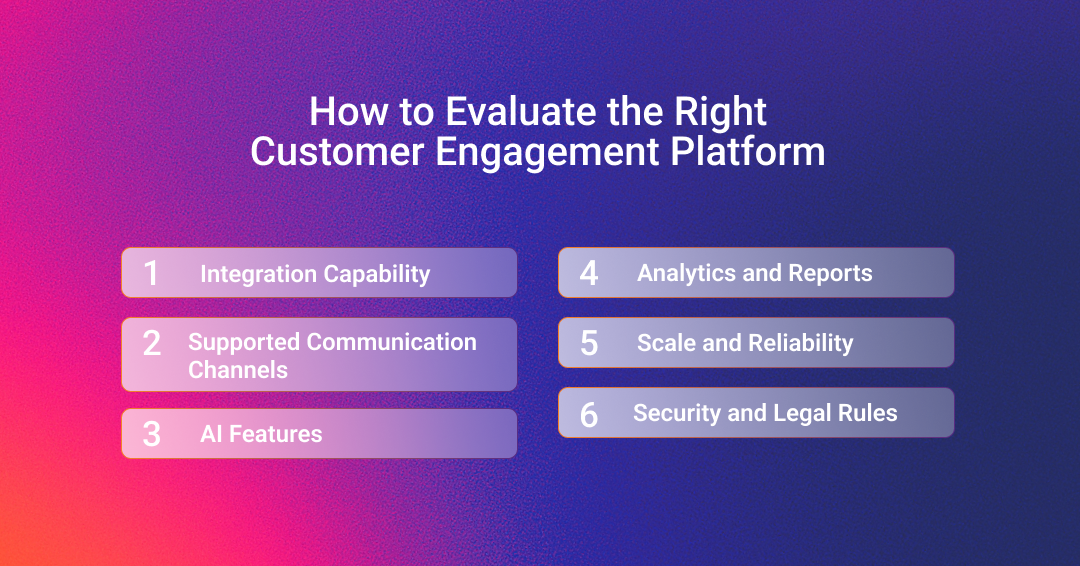
The platform must work well with your existing software. Verify that the CEP has ready-made links or strong APIs for your main systems. These include your CRM data and ERP software.
Also, make sure the CEP can update data instantly. It must read and write changes right away across all connected tools to keep the customer profile accurate.
The platform must include all ways your customers talk to you. Verify the CEP supports all needed channels: email, text (SMS), live chat, and phone calls. It must also include mobile alerts and social media.
The same rules must apply to all channels. This prevents the system from sending customers two different or repeated messages.
Review how AI will make your operations faster and smarter. See if the platform can use chatbots to handle common customer questions without human help.
Also, confirm the platform uses AI to spot key risks. For example, it should predict which customer might leave soon (churn risk).
The platform must provide useful information, not just raw data. Make sure all customer journey data is shown in one place.
Verify you can create your own reports on important metrics. This includes agent speed, issue resolution time, and campaign success.
The platform must handle your future growth. Check that the system can handle your current number of customers. It must also support the growth you expect over the next 3 to 5 years without breaking down. Review the service agreement for guaranteed uptime.
The platform must keep customer data safe and follow the law. You must confirm the CEP meets major industry security rules, such as ISO 27001. If your company works globally, check that the platform helps you follow data privacy laws. This includes laws like GDPR (Europe) or CCPA (California).
You can stop piecing together disconnected touchpoints and inconsistent automation tools. Mosaicx gives you a single, AI-native platform that combines all your channels to simplify and improve customer engagement.
Mosaicx Engage puts the power of conversational AI directly in your hands. It runs advanced intelligent virtual agents (IVAs) that deliver human-like interactions. The automation handles everything from routine requests to complex escalations, but unlike traditional chatbots, our IVAs can listen, understand, and respond in real-time with natural empathy.
Every customer conversation feels personal, but your engagement efforts don’t end just there. We also offer Insights360 to turn every interaction into actionable data.
The built-in analytics tracks what works, what doesn’t, and where you can improve next. That means you get scalable, efficient support without losing the personal touch that builds loyalty and trust.
Ready to see how it works? Let’s schedule a demo and show you what seamless customer engagement looks like.

Conversational AI is rapidly becoming a critical tool for businesses of all sizes. It can help businesses improve customer service, increase sales,...

One of the most common pain points for any customer service business is the cost of unanswered calls. You not only frustrate your customers who might...
.png)
Modern contact centers operate in a fundamentally different environment than before. There's a long line of customers coming through multiple...