
 Mosaicx
How to Build, Train, Test, and Deploy Conversational AI Solutions in 2026
Conversational AI is rapidly becoming a critical tool for businesses of all sizes. It can help businesses improve customer service, increase sales,...

Every conversation with a customer leaves clues about what they actually want. They don’t always have to say it out loud that a certain feature needs to work differently. This is up to you to figure out.
Conversation analytics helps you make sense of all those customer conversations without forcing your human resources to go through every interaction. The system automatically tracks every conversation or message thread to show you what customers are really saying and how they're feeling.
That clarity makes it easier to spot what’s not working, strengthen your support, and make smarter decisions that build loyalty and long-term growth.
Customer conversation analytics uses AI to make sense of all your voice and digital interactions. Your systems analyze calls, texts, chats, and emails through natural language processing and machine learning to show what your customers need, feel, and want.
This is done in real time, so you get clear customer insights right away during a live support call or sales chat. The immediate feedback is far more efficient than waiting for specific groups of customers to fill out surveys.
These insights stop your teams from making guesses or relying on delayed feedback loops. They give every team a direct line into the customer's mind. Sales can see what actually moves deals forward, marketing learns which messages resonate, and product teams get hard data on the issues customers raise most frequently.
The key difference between the two is that conversation intelligence only focuses on sales calls and meetings. It's intended to assist sales teams in closing deals faster by providing real-time coaching and keyword tracking.
With conversation analytics, the scope is broader in nature, analyzing customer conversations across all channels for multiple teams, including support, product, and operations, to reveal business trends and customer behaviors beyond sales.
Every customer interaction produces raw data that’s converted into intelligence you can use to drive measurable growth and revenue.
You're basically creating a single source of truth for your business through conversation analytics. That means replacing conflicting reports and anecdotal opinions with clear, shared customer insights to help every department make faster, smarter decisions.
It doesn't matter what channel the customer uses. Your AI systems automatically pull every conversation and message, and analyze them with NLP and machine learning.
They pick up on intent, sentiment, and context at a scale no human team can match. So, instead of scattered interactions, you get a clear, unified understanding of what customers are saying and how they feel.
Your dashboard displays what's trending in customer conversations without digging through recordings. You get alerts whenever something spikes, like negative sentiments, mentions of competitors, compliance issues, etc.
Your agents see suggested responses during live calls based on what worked before. You track how changes affect outcomes and adjust based on what customers tell you directly.
Conversation analytics enable your business to shift from a reactive to proactive customer service. You stop waiting for complaints and start predicting what customers need.
If a topic suddenly spikes or customer sentiment turns negative, AI flags it instantly. Those signals help you tackle concerns before they snowball into support backlogs or lost revenue.
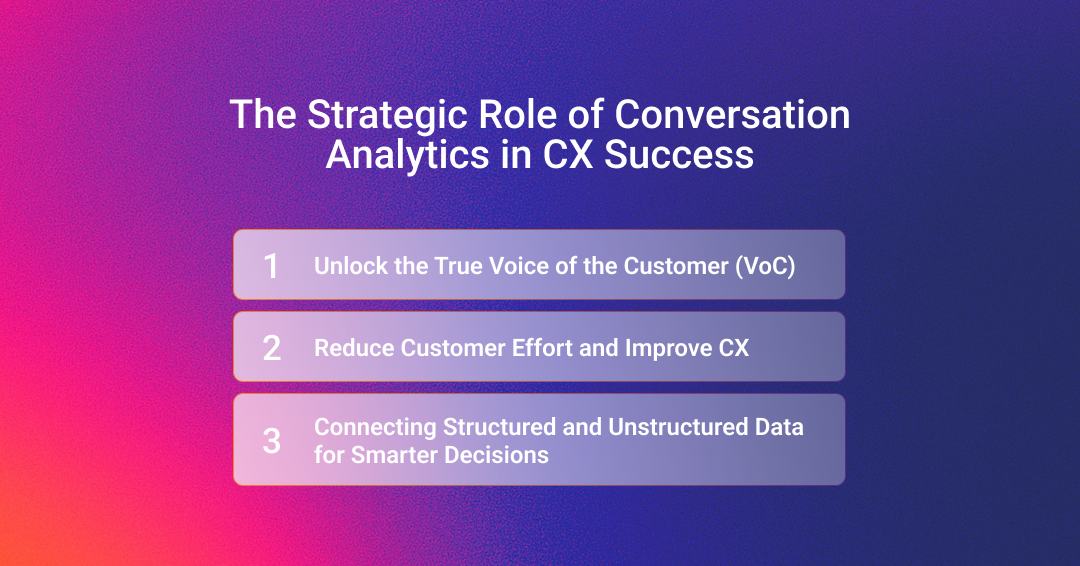
Someone might rate their experience fine on a survey but their chat shows they struggled for 20 minutes. You get real feedback from every interaction, not just the few who complete forms. The system spots emotional cues like frustration, confusion, and satisfaction, and reveals issues people mention but don't formally report.
When dozens of customers are calling up your agents to ask the same question, you know how and where your product is causing confusion or friction.
Password resets taking multiple attempts means your workflow needs fixing. Delivery questions flooding your support means your tracking needs work. These might sound basic, but they become pretty complex for large-scale businesses.
It's where conversation analytics becomes a major differentiator, showing exactly where customers get stuck, leading to faster resolutions and higher satisfaction.
Your CSAT score tells you customers are unhappy. Conversation analytics tells you why. Someone who gave a low rating makes a lot more sense once you connect it to their actual support conversations. You can see right away if the problem was shipping, features, or the service itself. Your teams stop guessing and start connecting the dots between what customers rate and what they actually experience.
Conversation analytics works across your business, not just one team. The same insights from customer conversations solve different problems depending on who's looking at them. Here's how companies put this technology to work.
When customers tell support they wish your product did something differently, that's product feedback you didn't ask for. Customer conversation analytics highlights these patterns across thousands of interactions. You see which bugs frustrate people most, which workflows confuse them, and what they expect your product to do—all without anyone having to manually read tickets.
Prospects always drop hints during calls that you might miss. They might mention what competitors offer, hesitate on pricing, or get excited about certain features.
Conversation analytics catches these moments. Your team sees which talking points helped close deals. This is especially helpful for new agents who might be struggling with the same customer issues. They get to see how their peers work.
Listening to random calls only tells you so much. Conversation analytics gives you a complete picture by uncovering patterns across every interaction.
You can see which agents excel at calming frustrated customers and which struggle with technical questions. Machine learning algorithms also detect emotional tones, revealing who sounds too robotic or scripted.
Hence, coaching becomes focused and actionable, helping agents improve exactly where they need to instead of wasting time on generic training.
Customers always signal frustration before they cancel, but you can't expect all your agents to catch every signal every time. Conversation analytics, however, is always working behind the scenes to automatically spot warning signs like tone shifts, repeated issues, loss of patience, etc. It alerts retention teams to quickly step in with targeted solutions before customers leave. This helps you build loyalty.
Reviewing every conversation for compliance issues is nearly impossible. It takes just too much time and resources, but conversation analytics does the same job automatically.
The system flags when agents skip required disclosures, miss security steps, or use language that violates policies. You catch issues in real time, reduce regulatory risk, and maintain consistent communication standards across your team.
The real value of conversation analytics appears when you connect them to your automation systems. It creates a constant feedback loop where every customer interaction generates data that tells the system what to automate, while also tracking how that automation performed for the next time a similar customer interaction appears.
This loop is why most modern contact centers are connecting their analytics platforms to AI-driven virtual assistants as a way to directly feed their systems.
This connection runs both ways. AI chatbots collect information during automated chats, then hand that context to human agents when needed. This cuts down on how long agents spend gathering background information.
Real-time tools can flag issues as they happen. When conversation analytics notices an agent having trouble with a customer objection, the system can pull up helpful articles or suggest responses right then.
The whole system learns as it goes. Analytics finds problems, automation fixes them at scale, and the cycle repeats, making the next one smarter.
While customer conversation analytics offers clear benefits, deploying it at enterprise scale raises real challenges. Here’s a look at four of the most common ones and how to address them.
Every interaction contains customer information that your platform must keep safe. This applies to every industry, more so for healthcare and finance, where data breaches or misuse destroy any trust that you've built with customers at that point.
The solution is enterprise-grade encryption protocols, which secure data in transit as well as during storage. Have role-based access controls to restrict who sees what, and maintain audit logs to track usage.
Not to mention that regulatory compliance, such as with GDPR and HIPAA, is non-negotiable: It's one of the first things you should be asking vendors to ensure that your automated systems are fully compliant-and safe to use-from day one.
Global customer bases require conversation analytics tools that understand multiple languages, accents, and cultural nuances. In such cases, you can use advanced NLP models that understand speech, sentiments, and intents across multiple languages. Such self-learning AI systems keep on using localized data to improve their accuracy levels to better support diverse customer groups.
We've already noted that conversation analytics work best when connected to existing tools and systems. However, that's sometimes a hurdle in itself if the analytics platform doesn't integrate properly with CRMs, CX dashboards, etc.
API-ready solutions integrate easily with existing workflows without custom development. They are also easily scalable, enabling you to process high volumes of calls, chats, and emails without service disruptions.
Poor-quality data can make your NLP models biased against certain groups of customers. It's why organizations must do regular audits to ensure their models are working accurately.
It also requires organizations to standardize and refine their existing datasets so the models are trained on reliable, unbiased information. It's something you have to figure out before implementing a conversation analytics platform.
Chaos is part of the job for any contact center. Mosaicx offers tools and platforms that help you control that chaos and turn it into your advantage.
Our AI-native CX platform, Engage, uses conversational AI to listen, understand, and respond to customers in real time across voice, chat, SMS, and email. Your organization gets intelligent virtual agents (IVAs) that are online 24/7, managing all your daily interactions as well as internal workflows without any need for human oversight.
Engage is built on streaming speech-to-speech AI and supports multilingual and accent recognition, letting your IVAs feel more natural and empathetic. It comes highly accurate out of the box and learns continuously, getting smarter with every exchange. It also pulls in data from your existing systems to create tailored, personalized conversations.
Meanwhile, Insights360, our built-in analytics engine, tracks every conversation, from the first dial to disconnect, across self-service IVAs and live agents. It highlights friction points, customer sentiment, and trends you can act on immediately, giving your teams clarity on where to improve and which processes to optimize.
Ready to see our platform in action? Schedule a demo and discover how we can transform your contact center into a hub of insight, loyalty, and growth.

Conversational AI is rapidly becoming a critical tool for businesses of all sizes. It can help businesses improve customer service, increase sales,...

One of the most common pain points for any customer service business is the cost of unanswered calls. You not only frustrate your customers who might...
.png)
Modern contact centers operate in a fundamentally different environment than before. There's a long line of customers coming through multiple...