
 Mosaicx
How to Build, Train, Test, and Deploy Conversational AI Solutions in 2026
Conversational AI is rapidly becoming a critical tool for businesses of all sizes. It can help businesses improve customer service, increase sales,...
Unclaimed prescriptions are becoming a real headache for pharmacies. Every bag left sitting in the will-call bin means lost revenue, wasted effort, and a patient who’s probably missing their medication.
Most of the time, it’s not neglect. People just forget, get busy, or can’t cover the cost. But for pharmacies, those small delays pile up fast. As return-to-stock numbers keep climbing, the impact hits both your workflow and your bottom line.
In this blog, we’ll break down why it’s happening and what you can do to keep prescriptions moving and patients on track.
Return to stock (RTS) happens when patients don't pick up their prescriptions. Pharmacies go ahead and ready medications, but the patient never shows up. Eventually, the meds have to be put back on the shelf, and the staff has to reverse the insurance claim.
Most pharmacy benefit managers wait 2 weeks before processing returns, but some have a stricter 10-day RTS policy. It depends on where the pharmacy is located because every state has different pharmacy regulations. Colorado, for example, doesn't allow you to return controlled substances to stock at all, making things more complicated.
Unclaimed prescriptions cost you time and money. You've already paid for the drug, had a pharmacist verify the prescription, filed a claim with the PBM, sent reminders to the patient, and used up inventory space, only to take it apart, remove it from your system, and reverse the insurance claim.
Pharmacies with poor return management can end up burning several hours of staff time every week. This multiplies for larger operations. However, skipping it entirely just means bigger PBM penalties, so you have no choice but to improve your RTS process to minimize loss.
Furthermore, every prescription return slows down your inventory turnover, meaning there's cash sitting on shelves doing nothing. You might even get stuck with them if they expire or can't be returned to the wholesaler due to state laws.
Then there's the patient care angle. High return rates signal medication adherence problems, and with pharmacies having reimbursements and bonuses tied to those same metrics, every missed refill hits the bottom line.
Your return-to-stock procedures fail for predictable reasons. Patients don't pick up prescriptions because of money, confusion, or simple logistics. Pharmacies compound the problem with manual tracking that eats staff time and misses deadlines. Here's what drives unclaimed prescriptions:
Transportation and timing create barriers. Not everyone can get to the pharmacy during business hours. They might lack transportation or be unable to take time off work.
Drug shortages prevent access. Essential medications go out of stock regularly. Patients show up to pick up insulin, antibiotics, or chronic disease drugs only to find out they're unavailable. The pharmacy fills the prescription, but can't hand it over.
Insurance rejections add more headaches. Many patients don't find out their insurance won't cover a drug until they're standing at the counter, and by then, they've already decided to skip it.
Manual tracking systems fail pharmacies. Staff use basic spreadsheets to track will-call bins. They miss PBM deadlines because they're juggling too many prescriptions by hand. Return management in pharma requires documentation, claim reversals, and patient follow-up—all impossible to scale manually.
Communication gaps lose patients. Pharmacies call once and move on. This doesn’t work because patients can miss the call, ignore unknown numbers, or forget to check their voicemail. Without repeated outreach through different channels, prescriptions pile up.
Complex pharmacy return procedures waste resources. Every abandoned prescription wastes staff time on processing, reversals, and stocking up. Those hours mount quickly when you're dealing with dozens of returns per week.
RTS adds another barrier to medication adherence, but pharmacies can follow a set of procedures to make their operation run more efficiently. This helps you keep more revenue and build patient trust while also dodging PBM penalties.
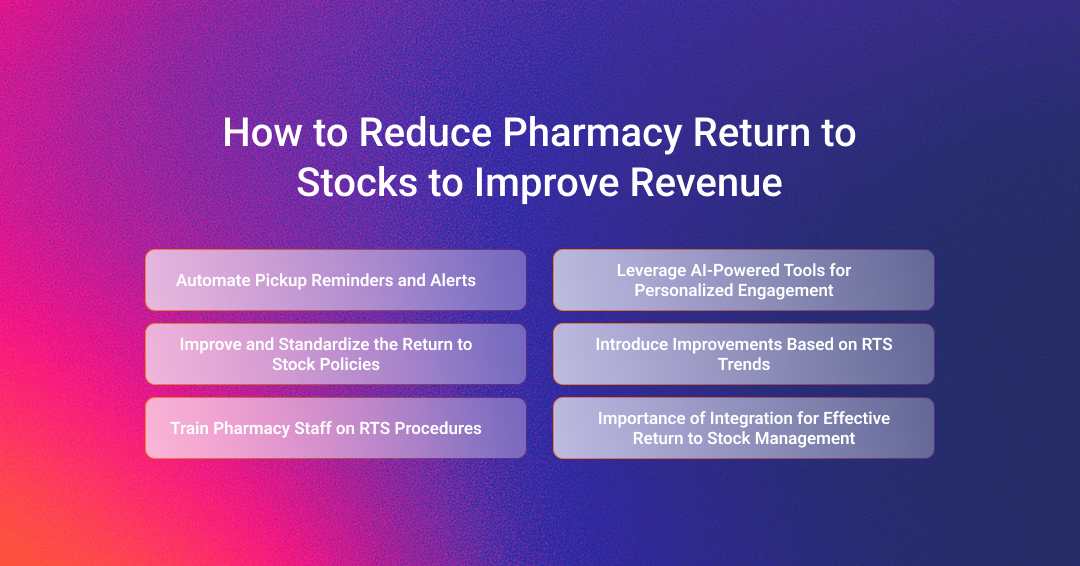
Expecting your staff to manually track down every patient is not realistic. That's hundreds of calls per week. Automated reminders remove that burden by sending alerts the moment a prescription is ready for pick up. The system also looks at past patient interactions, using channels they're most likely to respond to.
Your pharmacy's RTS policy needs to be consistent across the board. Document when prescriptions get flagged, who handles the reversals, when to call patients for high-value medications, and exceptions for controlled substances.
It's highly recommended that you only allow medications to remain in the will-call bins for the shortest outlined time. Check your state laws for the permitted range.
Additionally, track your PBM deadlines for every payer because missing a window means losing the full reimbursement. Set calendar reminders or use your pharmacy software to flag prescriptions approaching the deadline.
Training prevents mistakes that cost you money. Your staff need to know exactly how to log returns, reverse claims, and communicate with patients about unclaimed medications.
Most pharmacy software systems handle and track this process to make sure it's done correctly. But you should still run regular refreshers on PBM policy changes, state rule updates, and new software feature rollouts. Keep everyone current.
AI gives your pharmacy a sixth sense for patient behavior. The system recognizes when someone's likely to skip a pickup based on their history, letting you step in before that happens.
The reminders themselves also move from generic alerts to personalized messages. AI tailors your outreach for each patient, offering gentle nudges and cost-saving suggestions when it matters the most.
Keep a close eye on your pharmacy's RTS patterns. Maybe there's a specific drug that gets abandoned the most. You might be overstocking certain high-value medications. What times of day or week see the most pick-ups? This data gives you a roadmap that highlights where communication is breaking down or policies need to be revised.
You get the most out of your RTS tracking when it connects seamlessly with your pharmacy management system, inventory tools, and patient engagement platform. This all-round integration gives you a clear view of your entire operation and makes automation all the more efficient.
If a prescription on a shelf enters its last week, the system automatically sends a final text reminder. Following a couple of more days, the staff will be alerted to call the patient.
If the meds have still not been picked up, the system triggers an automatic reversal claim based on the high RTS risk. This is just one case example, but it shows how integration keeps your RTS process proactive instead of reactive.
If your pharmacy is constantly dealing with prescriptions left on the shelf, let Mosaicx show you a smarter way out of that cycle. We use conversational AI to help you reach patients with the right message, through the right channel, at exactly the right moment.
With Mosaicx Engage, your team gains intelligent virtual agents that automate routine tasks while improving adherence.
You’re not just spamming reminders into the void. Mosaicx Outreach adapts in real time, switching channels, refining messages, and keeping patients engaged in two-way conversations so they’re ready when pickup day arrives.
Early adopters of our platform see a 20-35% increase in refill pickups and up to 80% automation of routine inquiries like status checks and FAQs.
Schedule a demo today and see for yourself how Mosaicx equips you with the right tools to reduce RTS losses while improving patient engagement.

Conversational AI is rapidly becoming a critical tool for businesses of all sizes. It can help businesses improve customer service, increase sales,...

One of the most common pain points for any customer service business is the cost of unanswered calls. You not only frustrate your customers who might...
.png)
Modern contact centers operate in a fundamentally different environment than before. There's a long line of customers coming through multiple...