
 Mosaicx
How to Build, Train, Test, and Deploy Conversational AI Solutions in 2026
Conversational AI is rapidly becoming a critical tool for businesses of all sizes. It can help businesses improve customer service, increase sales,...
.png)
Many patients miss their medications. It's not on purpose. Life just gets in the way. However, every missed refill and uncollected prescription adds up to strain the healthcare sector. Rx alerts help by reminding patients when they need to step up. The result is better adherence, improved outcomes, and fewer prescriptions left behind.
Rx alerts are notifications from pharmacies to keep you updated about your prescriptions. They arrive as text messages or app notifications to remind you when it's time for a refill or pickup.
You can even reply directly to some Rx text alerts to request a refill. If there's a preference or situational need, Rx alerts can also be pushed through automated calls.
However, keep in mind that these alerts are different from clinical alerts. The latter warns doctors about drug interactions or dosing errors. The former keeps patients in the loop regarding their prescription status.
Every uncollected prescription represents lost revenue, wasted effort, and missed opportunities to improve someone's health. It's a persistent challenge that Rx alerts help to address.
Nearly 30% of patients simply forget to request or pick up their refills. That's billions in reimbursements and bonuses that the pharma sector loses every year. Not to forget the hundreds of staff hours they have to waste on their RTS process.
Rx alerts address that forgetfulness problem. Nudging patients at the appropriate time closes the loop between prescription and actual intake. When people know their medication is waiting, they're more likely to pick it up and actually take it.
Pharmacies can't expect to use the same Rx alerts for every prescription. Some patients just need to know when their order is ready, while others might want to check shipment updates for specialty drugs.
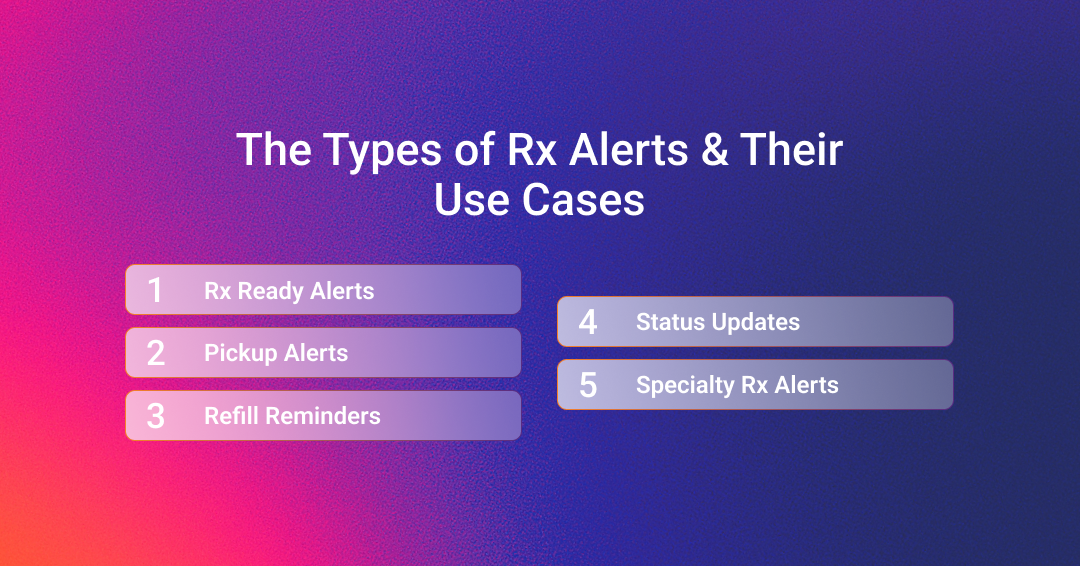
Rx alerts solve a basic coordination problem in healthcare. Patients need to know when their prescriptions are ready, and pharmacies need to make sure their medications actually get picked up. It's straightforward communication that prevents common breakdowns.
Setting up Rx alerts requires a bit of attention. Do it correctly, and patients remain up to date without getting overwhelmed. Do it incorrectly, and alerts turn into noise that gets ignored.
Rx alerts might seem easy to implement in theory. In practice, though, there are some problems that show up once systems go live. These mostly stem from the tech itself.
Patients simply stop reading messages when they receive too many of them. Send a few alerts in one day, and you've already lost them. They'll likely ignore any future messages from your pharmacy in the coming days as well.
You need to keep the volume low. Set clear rules when alerts should go out. One notification is enough for each event. So, one for arrival, one for when it's ready, a refill reminder before meds run out, and a single follow-up if it's still not picked up.
System integration can be tough. Rx alerts work best when they're linked to your pharmacy management system, prescription database, and any other tools you use. If they don't sync, your operations fall apart. It's how patients end up getting a "ready" text when their meds aren't ready at all.
The fix is rather simple. Test everything before launch. Have someone monitor every failed alert so problems are fixed before patients notice. It's best to use a staging environment where you can catch issues early.
The wrong channels can lose patients. You can't force someone to read their text messages at dawn, even if your automated system chose that time for the outreach. On that note, you can't force anyone to receive Rx status updates either.
The fix is making opting back in easy. Add a simple link in every message that lets patients manage their preferences instead of opting out completely.
Maybe they don’t want refill reminders but still want pickup alerts. Give them that choice. Track opt-outs and look for patterns. If timing or frequency is the issue, adjust before more people leave.
Privacy rules make messaging a bit tricky. HIPAA states that you can't just text someone their prescription details using standard SMS. That's protected health information that should only be sent via a secure channel.
The workaround is keeping messages vague while relating to the patient's current prescription or care. For example, "Your prescription is ready for pickup at Medicsi Pharmacy on Main Street".
However, as we noted elsewhere in the blog, personalization solves a lot of engagement problems, but that requires you to use app notifications to align with HIPAA rules.
Your missed refills are an opportunity to establish stronger patient relationships. Mosaicx automates your routine communication, but our AI-driven platform goes beyond just sending generic reminders at scale. We make every interaction feel personal, helping your pharmacy drive better health outcomes, higher adherence, and measurable growth.
Mosaicx Engage deploys intelligent virtual agents (IVAs) that handle everyday patient interactions with natural, human-like conversations. They are powered by conversational AI, so these virtual agents don’t just relay information; they listen, respond, and adapt in real time.
Confirming a refill? Following up on a missed pickup or dose? Our IVAs hook seamlessly into your existing system to meet and guide patients where they are without adding to your team's workload.
Your pharmacy also gets access to Mosaicx Outreach, giving you the power of RCS messaging. Your refill Rx alerts immediately become interactive experiences. Patients can tap to confirm refills, reschedule pickups, or request delivery right inside the message.
We’re seeing refill pick-up rates increase by 20-35%, a lift that directly translates into fewer treatment gaps, stronger adherence, and a healthier bottom line for your pharmacy.
Your next step is scheduling a demo, and seeing for yourself how our tools tailor to your workflows, how data shows up in your dashboard, and how you can start closing those gaps today.

Conversational AI is rapidly becoming a critical tool for businesses of all sizes. It can help businesses improve customer service, increase sales,...

One of the most common pain points for any customer service business is the cost of unanswered calls. You not only frustrate your customers who might...
.png)
Modern contact centers operate in a fundamentally different environment than before. There's a long line of customers coming through multiple...