
 Mosaicx
How to Build, Train, Test, and Deploy Conversational AI Solutions in 2026
Conversational AI is rapidly becoming a critical tool for businesses of all sizes. It can help businesses improve customer service, increase sales,...
Patients don't wake up one day and choose to miss their meds on purpose. They stop doing so because managing refills and schedules becomes harder.
Missed refills, limited access to care, confusing instructions—each missed dose adds up to represent a missed opportunity for pharmacies to keep patients healthier and more engaged.
With lost revenue now in the mix as well, more pharmacies are starting to treat medication adherence as more than just a box to tick.
Here's a startling fact: the United States healthcare system loses $290 billion every year to poor medication adherence. This creates both a problem and an opportunity for pharmacies in the country.
Every healthcare plan knows that patients are going to end up back in hospitals if they don't take their medications. So, they're shifting money toward pharmacies that can prove they're helping patients stay on track.
You can think of pharmacy adherence as a new performance metric. The ones that do a good job are the ones that get bonuses and access to new revenue streams beyond traditional dispensing fees.
Since better adherence means better reimbursement, more and more pharmacies are investing in automated adherence systems and support programs. It helps serve patients at scale while pumping up better satisfaction and loyalty scores.
The barriers blocking pharmacy adherence fall into four categories that affect patients differently depending on their situation and background.
Cost barriers hit hard. A large number of patients worry about how much their next dosage will cost. They are likely to modify their prescriptions for cheaper alternatives or skip them altogether after learning their medication costs at the counter.
Complexity creates confusion. Patients taking multiple medications at different times often struggle to keep track of them. The elderly, in particular, may take the wrong medications or dosages.
Knowledge gaps add more barriers. Patients are most likely to skip their meds if they feel fine. A common example is how most patients only take their blood pressure pills when they start feeling symptoms. They don't realize it's an ongoing treatment.
System-level problems double it all. In low-income communities, getting to a pharmacy is a challenge in itself. Poor communication and follow-ups also sum up to affect medication adherence.
It begins with understanding why patients forget in the first place. Then address those barriers with a blend of smart tech, personalized care, and clinical expertise.
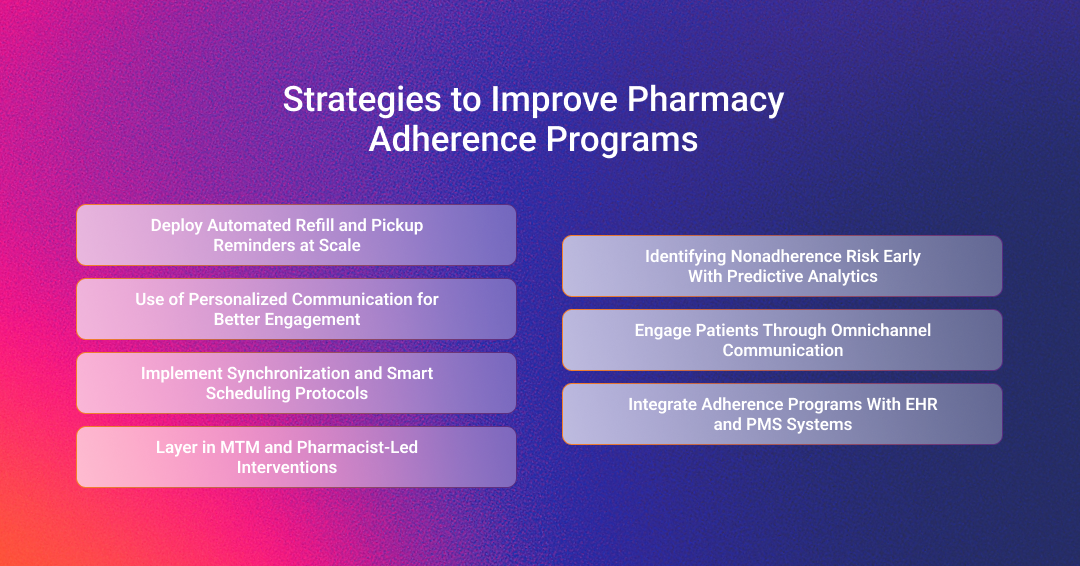
Patients forget. It's the simplest barrier to pharmacy adherence, but it's also one of the easiest to fix through automated reminders. Text messages, emails, and voice calls keep medications top of mind without requiring staff to manually track and call hundreds of patients.
Text messaging is especially compatible with most pharmacy systems and is the most effective. Rich Communication Services (RCS) from platforms like Mosaicx can boost conversion rates by 50-80% compared to standard SMS or email. That’s because it lets you send interactive, branded messages with buttons and visuals that make it easier for patients to engage and respond.
Patients don't respond well to generic reminders. They want messages that feel like they were sent just for them. This means both timing and channels matter.
Sending a refill reminder a day before the patient runs out, especially through an unpreferred channel, doesn't have the same impact as sending multiple reminders a week before through their preferred channels.
It's not unusual for patients to have to go to the pharmacy a number of times a year. But some patients may find themselves going dozens of times just to collect different prescriptions. That's a lot of travel. Medication synchronization simplifies that routine by grouping all their refills into one pickup day each month.
Patients can pick the day they like based on their convenience. Their pharmacy handles the rest. This also makes it easier for the staff to proactively ready meds instead of passively filling prescriptions on a varying schedule.
A quick chat with a pharmacist can make a big difference. It can explain why a prescription still matters even after the symptoms are gone, or talk through side effects and possible alternatives. These small conversations build trust over time, and that keeps patients on track with their treatment.
Also, keep in mind that automated reminders bring the patients into the pharmacy. After that, it's up to the pharmacist to get them to take their meds properly.
Pharmacies can improve these efforts through Medication Therapy Management programs. This includes structured ways for medication reviews, pharmacotherapy consults, anticoagulation management, immunizations, and other clinical services.
AI-driven predictive systems enable pharmacies to act before problems happen or become bigger. That's a smarter approach than reacting after someone's already been non-adherent for weeks or months.
AI uses factors like behavior patterns, demographics, symptoms, etc, to flag patients likely to face challenges with their treatment. For example, a group of patients with increasing gaps between visits and missed refills signals they are about to fall off track. They can then be proactively targeted to improve outcomes.
Pharmacies can't expect patients to stay limited to a certain mode of communication. Text messages are effective, but older patients might respond better to a phone call from a real person. The point is to meet patients where they are or want to be. Omnichannel refill reminders are, hence, convenient for patients and help drive up pharmacy adherence.
Real-time updates on missed refills, side effects, or other treatment changes enable pharmacists to respond earlier. It only works, though, when your EHR and PMS systems are fully integrated. Without that integration, your staff may be stuck toggling back and forth between systems and attempting to piece together patient information, leaving them with a rather disconnected adherence program.
Pharmacies can’t expect their staff to boost medication adherence while manually keeping tabs on hundreds of patients. It’s just not realistic, or sustainable for that matter.
Automation and AI tools act as a bridge to address both challenges. They reduce the daily workload, while also catching issues before they turn into serious health problems.
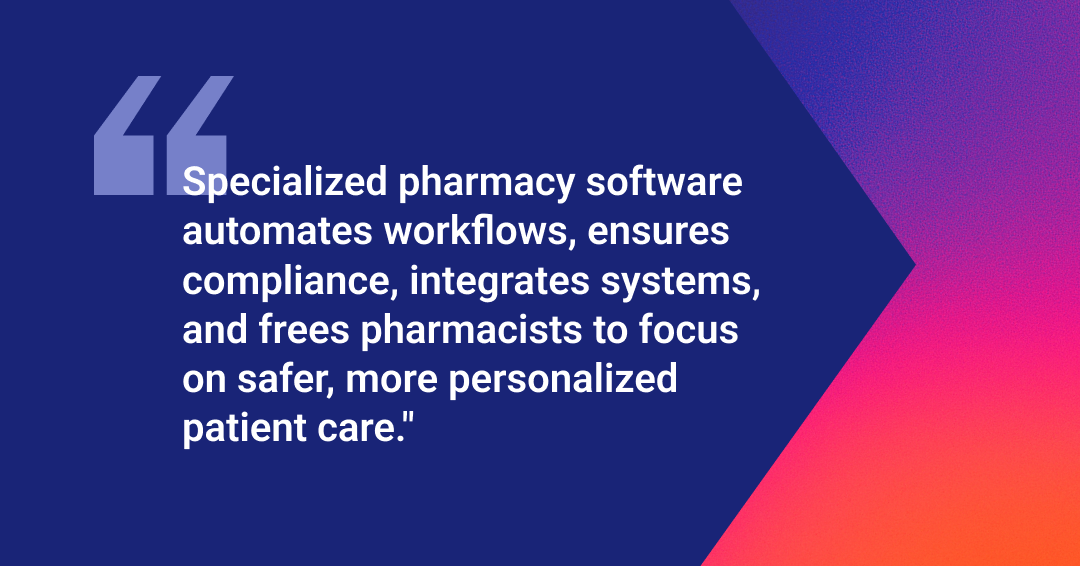
Routine tasks like tracking inventories, matching prescriptions, and processing refills are now being handled automatically. It's not only fast and efficient, but also gives pharmacists the time to be more involved with their patients. This is how they build a stronger foundation for long-term adherence.
Pharmacy adherence programs using AI sort through thousands of lines of patient data every day to find patterns. Instead of manually reviewing hundreds of profiles, your staff gets a list of patients who need attention today. The system does all the heavy lifting, leaving the pharmacy to lead the conversation with patients.
Hence, AI and automation help pharmacy adherence become scalable. One pharmacist can effectively support more patients because the AI handles pattern recognition and routine communication.
Your good intentions are not enough to keep patients on track with their medications. You need time, consistency, and the right tools working behind the scenes. Mosaicx helps pharmacies tackle that adherence challenge at scale with our conversational AI.
We give you access to our intelligent virtual agents (IVAs) that make it simple for you to automate outreach, engage patients across multiple channels, and reduce drop-offs before they happen.
The best part is that your customers still get to experience the human touch. Our IVAs handle every interaction with the empathy and understanding you'd expect from your most trusted live agent.
Mosaicx also tracks and analyzes every interaction in real time via our Insights360 platform. You'll see exactly which messages are working, where service gaps are appearing, and how adherence rates improve over time.
In short, we don’t just give you another digital tool to play with. We give you a smarter, scalable way to keep patients engaged, improve medication adherence, and free your team from the busywork that slows them down.
Interested in seeing how that works? Schedule a demo today, and see for yourself.

Conversational AI is rapidly becoming a critical tool for businesses of all sizes. It can help businesses improve customer service, increase sales,...

One of the most common pain points for any customer service business is the cost of unanswered calls. You not only frustrate your customers who might...
.png)
Modern contact centers operate in a fundamentally different environment than before. There's a long line of customers coming through multiple...