
 Mosaicx
How to Build, Train, Test, and Deploy Conversational AI Solutions in 2026
Conversational AI is rapidly becoming a critical tool for businesses of all sizes. It can help businesses improve customer service, increase sales,...
Most customer issues never show up on a report. Surveys rarely tell the full story, and by the time you spot a trend, it’s already too late.
Customers share far more in online forums, social comments, product reviews, and support chats, but pulling all of that into one place is tough.
This is where AI-driven customer sentiment analysis helps. It reads feedback across every source and sorts the tone and emotion behind each message.
You get a clear view of how customers feel at every touchpoint. Related signals fall into place, patterns become obvious, and the insight you gain removes the guesswork from CX decisions. Let’s see how that actually works.
The system automatically gathers feedback from multiple sources, including support tickets, chats, online reviews, and social media posts. All that information is then processed to find context and meaning.
Natural language processing and machine learning help the AI spot emotional patterns; basically, reading between the lines of every conversation to figure out how customers actually feel.
Here's all that, step by step:
AI sentiment analysis helps businesses personalize every customer interaction. Take a live support chat, for example. The AI catches even the smallest emotional nuances to alert the human agent that the customer appears to be growing disappointed. From here, the agent can immediately change tone or escalate to a specialist.
This "readiness" approach means you spot negative feedback in real time and fix it before things get out of hand. It also matters for your metrics, improving first-call resolutions, cutting wait times, and shaping decision-making for better ROI.
Different types of customer sentiment analysis give different insights. Most organizations tend to start with one for a general idea before adding more emotional detection layers to dig deeper into specific problem areas.
AI sentiment analysis changes how your support teams handle customer feedback. It spots problems faster, guides better decisions, and helps keep customers from leaving.
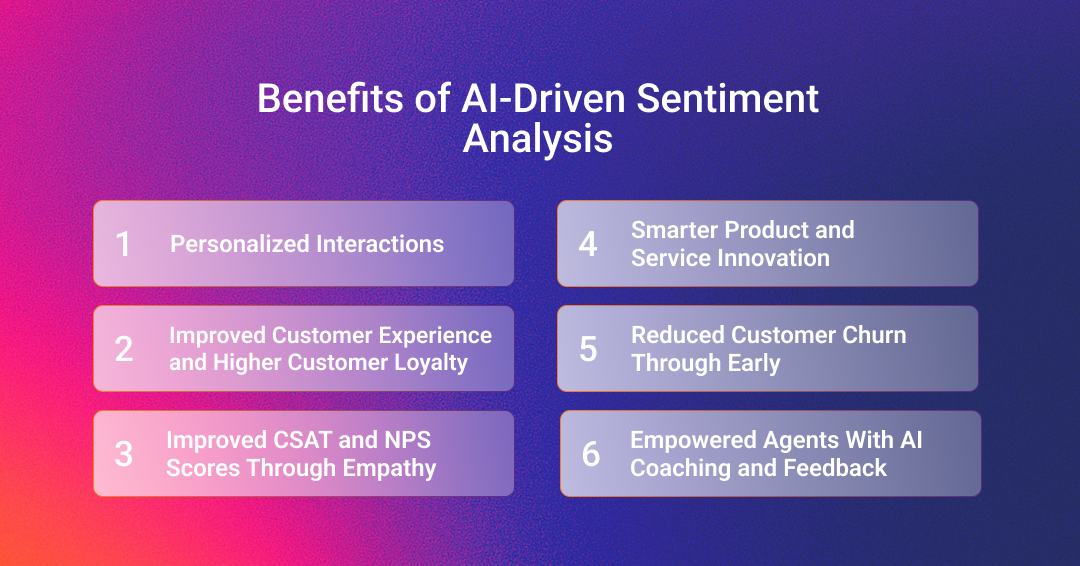
Sentiment analysis helps businesses respond in ways that feel more personal. When it picks up that someone is happy, it will trigger the live agent to suggest new features or upgrades that might interest them.
Hence, conversations stop feeling robotic because your responses aren't just based on the words customers say.
Watching sentiment as conversations happen lets you adjust on the fly. This means rerouting angry customers to your best agents, launching special recovery processes, or changing your approach before things go sideways.
The goal is always to achieve a fast resolution, but in a way that says you actually understand their needs. Also, you're responding within the moment instead of sending surveys two weeks later. This efficiency builds loyalty and trust.
Support that responds to emotions can bump CSAT scores up by 35%. When agents match their empathy to what the customer is feeling, instead of reading from a script, ratings improve. Companies that jump on issues based on sentiment data see satisfaction climb across the board.
Sentiment analysis allows the AI to tell you exactly which features work and which ones drive people away. So, product teams no longer have to guess what to build next.
Tracking how often negative sentiment surfaces gives you a solid signal that someone's about to leave. Digging into customer reviews alone can flag at-risk customers with over an 85% accuracy. This gives you time to address their negative sentiments before they leave. Most modern businesses set up automatic alerts for sentiment drops and cut their resolution time in half, saving accounts in the process.
Sentiment analysis shows agents exactly how customers reacted to different approaches during calls and chats. They get real feedback on what landed well and what didn't. Hence, the whole team gets better at handling tough situations and connecting with customers over time.
Below are some real-world applications and examples to showcase how sentiment analysis is driving positive customer experiences.
VoC initiatives enable organizations to monitor contact center conversations, social media mentions, and post-purchase surveys to get a complete view of how customers feel at different touchpoints.
Netflix uses analytics that monitor audience sentiment and social media chatter to identify not only which genres are trending but also the gaps in content and viewer preference fluctuations. This helps them decide what to produce based on what people actually want.
Companies track how often their brand is mentioned and how, compared to competitors. This allows you to find places where your competition is in a weak spot and where you excel.
Perhaps a retailer will find its customers complaining about a competitor because of the shipping time. Now, it has an opportunity to make fast shipping its main selling point to attract those customers.
Reading tone and emotion during live interactions helps agents respond better and faster. The AI system also flags which support issues frustrate customers the most, so your team knows what to tackle first.
During the pandemic, James Villas used topic and sentiment analysis to automatically identify and route urgent tickets to priority queues, cutting first reply time by 46% and increasing CSAT by +11%.
It comes down to matching what the platform can do with what your team actually needs. There are plenty of sentiment analysis solutions in the market, but don't get distracted by their flashy AI features or demos. Your focus should be on investing in a system that helps your business's specific situation.
Your customers are already telling you what they think. Mosaicx just helps you listen better. Our AI-driven solutions capture voice, chat, SMS, email, and social text in one place, turning scattered feedback into clear sentiment insights that show how your customers feel at every interaction.
With Engage and Insights360, you can track tone, emotion, and intent across all channels. All of this data flows directly into the Mosaicx dashboard, giving you a single view of where customers are satisfied and where friction exists.
These insights help your team improve CX, strengthen loyalty, and make decisions that support measurable growth.
See it in action. Schedule a demo and experience how Mosaicx turns customer sentiment into actionable intelligence.

Conversational AI is rapidly becoming a critical tool for businesses of all sizes. It can help businesses improve customer service, increase sales,...

One of the most common pain points for any customer service business is the cost of unanswered calls. You not only frustrate your customers who might...
.png)
Modern contact centers operate in a fundamentally different environment than before. There's a long line of customers coming through multiple...