
 Mosaicx
How to Build, Train, Test, and Deploy Conversational AI Solutions in 2026
Conversational AI is rapidly becoming a critical tool for businesses of all sizes. It can help businesses improve customer service, increase sales,...

What does great customer service look like? It’s delivering timely solutions that leave customers satisfied.
But lately, customers expect more and more, and new technology keeps raising the bar. For businesses, keeping up with these constantly increasing expectations can be a real struggle.
The truth is, you cannot meet today's customer expectations without help. Businesses need to use smart technology to support their teams. That is how their service stays sharp and relevant.
On that note, the contact center determines customer experience (CX). It also contributes directly to return on investment (ROI). Upgrading this requires replacing outdated systems and inefficient workflows.
This replacement process provides various operational benefits. It significantly improves CX quality. It allows the center to handle all communication channels in one location. These updated tools ensure the business remains flexible and competitive.
If you plan to upgrade your contact center, this blog explains how to improve customer experience and increase returns by using automation, AI, and data-driven methods.
Most small and medium-sized businesses depend on their contact center performance. Inefficiencies like long wait times, repeated contacts, limited context, or restricted communication channels can cost them a fortune. These issues lead to customer frustration and eventual churn.
Contact center modernization can help solve the common efficiency issues associated with on-premise help desk systems or legacy ticketing systems. The following are some of the challenges outdated contact center-dependent businesses face:
When customers have to call repeatedly to resolve one issue, satisfaction drops, and loyalty is reduced. A key reason is that agents have to switch between tools. On-premise platforms often lack deep integration with CRMs or knowledge bases. This activity lowers FCR and increases customer frustration.
Customers don't like waiting. Even short delays can make them drop a call, and most of them do it without saying a word. These drop-offs hurt agent efficiency and result in thousands of dollars in annual cost per agent.
Legacy systems typically focus only on voice or ticketing functions. Inquiries via chat, social media, SMS, or messaging apps are handled by disconnected systems. But most of the customers look for personalized service across all channels.
To satisfy these customers, agents need to access unified customer data. This eliminates the need for customers to repeat information. Repeating information often causes fragmented and frustrating service journeys.
Manual tasks, rigid workflows, and poor scheduling cause agent stress and dissatisfaction. This results in high attrition rates, where each agent's exit disrupts service continuity. It also increases training costs for the new staff you'll be hiring.
Legacy infrastructure limits access to real-time customer data. This complicates personalized or adaptive service delivery.
Data is often stored in separate systems. This prevents agents from getting a complete 360-degree view of the customer. The result is slower, less effective support. This also wastes agent time.
Traditional help desks usually lack active reporting tools. Leadership sees ticket volumes but misses real-time data. This includes sentiment trends, process bottlenecks, or agent performance.
Without visibility into key metrics like FCR, CSAT, or queue health, continuous improvement is based on assumptions. This practice compromises effective customer retention.
Let’s take a look at a case study showing how digital contact center modernization benefits businesses.
Dutch multinational bank ING provides a clear example. ING faced high volume, receiving 85,000 customer queries weekly. To solve this, ING developed a Generative AI chat assistant utilizing Natural Language Understanding (NLU). This provided a more fluid conversation.
Within seven weeks, the virtual agent served 20% more customers than traditional support channels. This approach improved customer satisfaction and loyalty.
The case confirms that advanced technology is necessary to modernize service and scale operations effectively.
Here are some of the advanced technologies to upgrade your contact center modernization tech stack:
AI agents and chatbots give customers quick answers at any time. Most people expect immediate support, even late at night or on weekends. Requests like password issues or delivery questions often come in outside normal hours. A contact center with fixed operating times cannot meet this demand. That’s where call center modernization becomes necessary.
AI agents address this challenge directly. They combine conversational AI, generative AI, and agentic AI. This automates customer service.
AI agents function as dynamic virtual assistants for customer self-service. They are accessible across channels like voice, chat, and social media. They’re available 24/7 and communicate fluently in several languages.
This automation offloads repetitive tasks from human staff. They resolve common inquiries quickly. This includes questions about orders, shipping, or basic troubleshooting. This frees human staff to focus on high-value interactions. This shift improves agent morale and retention rates.
Businesses use conversational AI to automatically manage high volumes of queries while still delivering accurate, personalized responses across every channel.
The technology understands and responds to text and voice in a natural, human-like manner, and continually improves over time by learning from every interaction.
This leads to faster responses, shorter wait times, and a noticeably better customer experience, making conversational AI an important driver of modern contact center transformation.
AI assistants provide guidance to improve decision-making. However, the technology is shifting toward Agentic AI, which moves beyond simple assistance to active orchestration.
While a traditional virtual agent complements human effort by suggesting next steps, agentic AI manages and coordinates complex workflows across multiple systems.
This evolution relies on an advanced AI stack:
The transition from a standard AI assistant to Agentic AI changes key operational functions:
From Information Retrieval to Contextual Action: Standard AI assistants extract details like policies to show the agent. Agentic AI retrieves this data and immediately prepares the necessary system actions or forms required by that policy, eliminating manual setup.
From Response Suggestions to Process Execution: They offer text options for communication. Agentic AI drafts the response and simultaneously orchestrates the required backend resolution, such as processing a refund or updating an address, awaiting only final agent approval.
From Message Autocomplete to Workflow Prediction: AI assistants predict the next word. Agentic orchestration predicts the next stage of the support lifecycle, automatically opening the correct tools and logging relevant data before the agent requests it.
From Tone Adjustment to Protocol Enforcement: AI agents revise grammar. Agentic AI ensures that all communications and actions strictly adhere to regulatory compliance and internal orchestrations without constant human oversight.
According to Salesforce research, current AI assistants help 60% of agents save time and 68% report better service delivery, thereby enabling effective call center modernization. The move to Agentic orchestration builds on this baseline, aiming to resolve end-to-end customer issues rather than just supporting individual tasks.
Cloud contact centers offer various competitive advantages over traditional systems. They are known for better flexibility and scalability. Phone lines and digital channels are added instantly online, allowing setup in minutes instead of weeks. Systems are not tied to a single location, which offers global access.
They reduce operational costs by eliminating the need for expensive hardware, maintenance, or office space. Businesses pay per user or line. This allows them to easily add or remove capabilities as needs change.
Cloud platforms offer advanced features. These systems work with other tools and use AI, like machine learning. They offer 99.9% uptime with automatic backups. Also, their security meets standards such as GDPR and HIPAA.
These platforms fully support remote work. Agents can use any device from any location. Team leads maintain oversight using tools like real-time monitoring. This remote capability has been shown to increase team productivity.
A modern UCaaS contact center significantly improves communication. It goes beyond the old call center model. It provides one full system for customer service, using every channel. This clearly helps how businesses operate and relate to customers.
A UCaaS system brings many communication channels together. It is one system that manages all customer communication. This helps businesses give the same level of support across calls, email, and live chat.
The system includes intelligent call routing and useful data reports. Routing sends customers to the right staff member. Reports show how customers behave. These features help staff give great service. Since everything is on one easy platform, work is simpler and faster.
Customers expect to talk to businesses how and when they want. A UCaaS center lets companies meet this need directly. They provide support on all channels, so customers always get answers. This improves satisfaction and loyalty.
With multi-channel and Multimodal engagement solutions, business contact centers can easily handle phone calls, emails, live chats, and social messages all from one spot. Everyone works from a single, unified screen. This saves agents the hassle of switching between different systems.
Here’s how it works:
You integrate the software into your current systems, like your customer records (CRMs). Every time a customer contacts the CS center, smart routing sends the request to the right agent. Tools like chatbots handle simple questions while the team addresses more challenging problems.
The key benefits of multichannel and multimodal engagement solutions include:
The biggest win is connecting all these channels. When systems share information, the customer's complete history is available to the agent. Data is shared smoothly, so customers don’t have to repeat themselves. This makes service easier and more personal.
RPA refers to the bots that handle routine contact center tasks. These digital assistants execute actions like logging in and copying data quickly. This frees human staff for complex customer issues. The bots efficiently manage background work, playing an essential role in contact center transformation.
The key applications of RPA include:
Manual call review and subjective scoring create inconsistency. They also prevent managers from seeing real-time floor activity, which slows down contact center transformation. Artificial Intelligence (AI) solves these issues.
AI enables contact centers to analyze all interactions. It spots performance trends instantly. This way, it helps managers focus on improving operations instead of reacting to problems. It also improves key metrics like FCR and CSAT.
Here’s how AI improves operations:
AI helps you understand where customers are in their journey and what they’re likely to do next. It pulls together data from across your systems, groups customers based on their behavior, and automatically updates journey maps in real time.
It also reads sentiment during conversations, spots pain points, and highlights the moments where a more personal touch can make a difference, even when you’re dealing with thousands of customers at once.
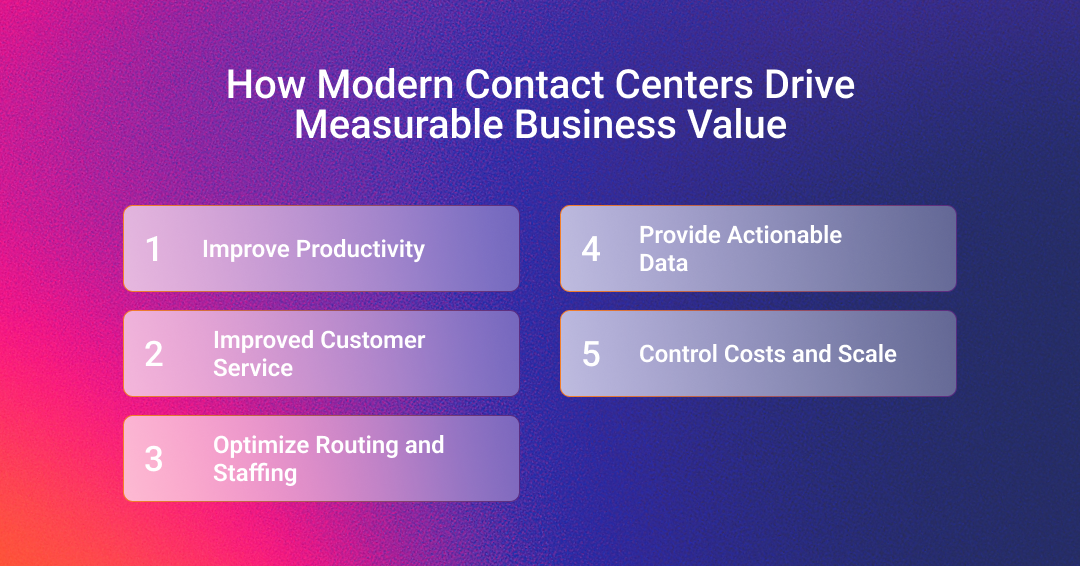
AI helps contact centers accelerate growth and improve business results. There are several benefits of adopting the latest technology in the contact centers, including:
Many enterprise contact centers still rely on systems built years ago. These systems often do not connect well with modern cloud tools because they lack APIs. This keeps data locked in different departments. Agents then move between several screens to answer basic questions, which slows down service and increases costs.
Money is another barrier. Cloud platforms follow subscription models, so spending shifts from hardware purchases to recurring fees. Leadership usually takes time to approve this change.
Cultural issues appear once new tools are introduced. Some agents worry that automation will replace their roles. When managers do not address these concerns early, adoption drops. Weak change management often leads to delays and poor results.
The following strategies can make contact cener modernization a breeze:
A phased rollout reduces risk. Upgrading one area at a time allows teams to test new tools before moving to the next stage. Many companies start with simple features like automated FAQs, then move to larger systems such as CRM platforms.
IT and customer service teams need to agree on goals from the beginning. This ensures that technical decisions support actual workflow needs.
Clear communication and training help employees understand why the new tools matter and how these tools reduce repetitive tasks. This builds confidence and improves adoption.
Addressing these factors step by step gives organisations a steady path to contact center modernization without harming service quality or team morale.
We’re moving past basic chatbots. The future is AI that thinks ahead, solves problems on its own, and makes every customer interaction feel intentional.
A typical AI chatbot would explain to a customer about their delayed shipment. Agentic AI does more than that. It checks the inventory, figures out which warehouse has the item, fast-tracks the shipping, and updates the customer on the spot.
Businesses are already investing in making their agentic AI smarter, so it can take on even more complex, multi-step tasks that used to bounce between multiple teams.
Voice analysis tools are getting surprisingly good at reading the room. They know when a customer is starting to sound frustrated or confused, adjusting the conversation on the fly towards a fast resolution.
This can be as basic as alerting a supervisor to step in, to pulling up the customer's history to speed things up. Some teams even use these insights to coach agents by showing exactly where a call started to turn around.
More contact centers are using AI to spot patterns that signal trouble ahead. If someone logs in five times in two days without finishing their purchase, the system knows something’s up and flags them so you can step in before they bail.
Behind the scenes, these tools sift through interaction data to spot at-risk customers, forecast call spikes, and make sure tricky cases get routed to the right experts from the start. You end up solving issues people haven’t even realized they have yet.
Businesses are using AI to move towards a “We already understand the issue and here’s the solution that fits you” approach. The moment a customer reaches out, AI pulls up their whole history to shape the conversation on the spot.
So, a tech-savvy customer might get step-by-step troubleshooting, while someone who prefers simple answers might get a different styled answer. The system adjusts tone, detail, and even the channel based on what’s worked for that person before.
It's time to step into a contact center that does more than just respond. Mosaicx offers AI solutions that anticipate your customers' needs, adapt in real time, and deliver fast, accurate resolutions to help your business stay ahead.
Every interaction becomes smarter, more personalized, and tied to measurable ROI instead of just vanity metrics. We’re talking about building the kind of customer loyalty and growth every modern contact center needs.
Engage, our conversational AI, brings your customer interactions to life. Its intelligent virtual agents (IVAs) understand natural speech and respond likewise in natural language.
They are also online 24/7, fluent in multiple languages, and understand the context in each one of them. Your business supports a global base around the clock, handling everything from payments to support tickets, without needing any human oversight.
Insights360 runs parallel to your automated support. It's our built-in analytics platform that gives your team a clear view of the entire customer journey, identifying root causes of escalations, tracking key metrics, and showing exactly where agent workflows or training can be improved.
See all of that in action. Schedule a demo or speak with a Mosaicx specialist today and discover how your contact center can work smarter, faster, and more efficiently.

Conversational AI is rapidly becoming a critical tool for businesses of all sizes. It can help businesses improve customer service, increase sales,...

One of the most common pain points for any customer service business is the cost of unanswered calls. You not only frustrate your customers who might...
.png)
Modern contact centers operate in a fundamentally different environment than before. There's a long line of customers coming through multiple...