
 Mosaicx
How to Build, Train, Test, and Deploy Conversational AI Solutions in 2026
Conversational AI is rapidly becoming a critical tool for businesses of all sizes. It can help businesses improve customer service, increase sales,...
.png)
Digital customer engagement is how you interact with customers through digital channels. Your strategy focuses on continuing conversations across chat, email, text, or apps without making customers repeat themselves. So it's more about making customer interactions feel relevant instead of sending them generic messages.
For example, a customer opens your website to ask a chatbot a question. They receive a quick response but then decide to reach out through a text to continue the same conversation. The agent who responds won't ask them for more information. They will already know the full context.
Digital customer engagement makes these handoffs feel invisible. This level of continuity is now part of how modern businesses earn trust and retain customers.
Customers across industries have become incredibly demanding. They want personalized solutions and instant resolutions. They’ll reach out through channels of their own choice and expect your agents to know exactly what they need.
Digital customer engagement directly affects your ability to meet these expectations. Retention improves when customers don't have to work hard to get help. A customer who finds an answer in your knowledge base or gets a fast response through chat is more likely to stay. They're also more likely to buy again.
The business impact shows up in measurable ways. You reduce your cost-to-serve because customers solve their issues themselves through self-service. Support teams instead focus on complex problems that actually need human expertise.
Proactive outreach prevents issues before they require contact. Better agent tools improve efficiency without adding headcount.
For modern businesses, digital customer engagement uses technology to deliver better experiences at lower support costs while delivering more value over time.
You need a clear structure. The framework below outlines how to build a digital strategy that actually works.
Start with business outcomes. You need to define what success looks like before choosing tools or tactics. Metrics like resolution time, retention rate, and cost per contact matter to customers and the business.
Identify priority journeys. Not every interaction needs the same level of investment. Use customer journeys to find where engagement makes the biggest difference. Focus especially on requests that are commonly in large volumes. That and recurring pain points and moments that affect retention.
Match channels to customer needs and preferences. Some customers prefer text while others want phone calls. This is because chat is great for certain issues but complex issues can be explained better over a call. Create rules for when to use which channel and how to route requests appropriately.
Build smart self-service with personalization. Use customer data to personalize answers and recommend relevant content. Use analytics to predict what they need. Make it simple to find information and easy to get human help when needed.
Track performance against key KPIs and then let the data guide what you change next. Tactics that work early on don’t always scale cleanly so expect to optimize as volume and complexity increase. Strong feedback loops make that easier, helping you improve continuously without having to rebuild everything from the ground up.
Loyal customers are the highest-earning source for every business. They spend more on your products and services compared to one-time buyers. Digital engagement helps improve retention by shaping faster and more helpful interactions for everyone involved.
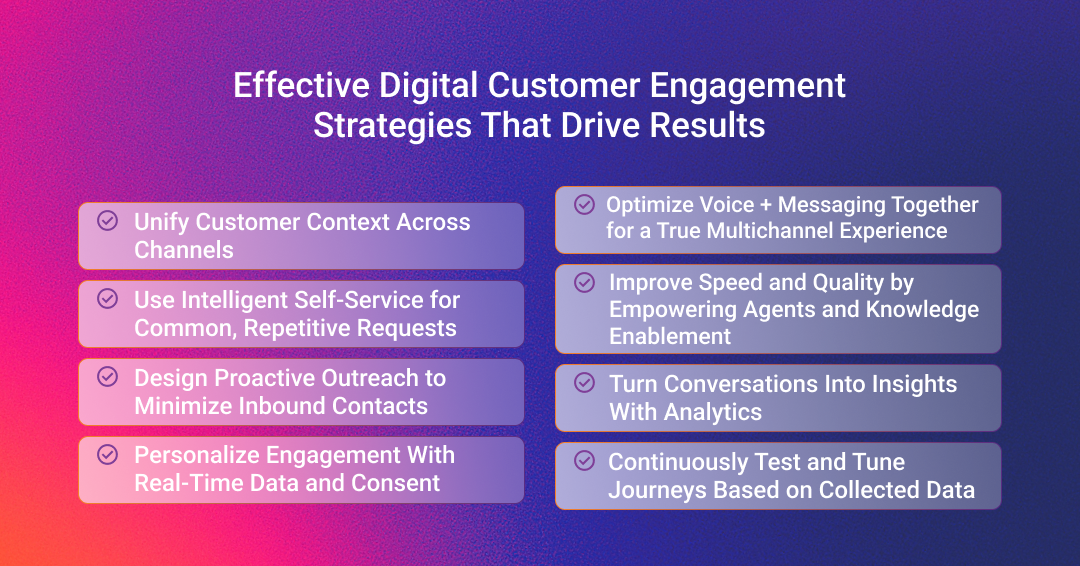
A unified view ensures that customers don’t repeat themselves across channels. Your agents instantly see the customer’s details, their purchase history, and account details in one place. They can go straight to a resolution without asking the customer to answer the same questions they did before to another agent in another channel.
This approach reduces handling time and improves first-contact resolution. That leads to better customer satisfaction as they always notice when your agents remember their last interaction.
Most customers prefer solving simple problems themselves. Self-service lets them do so while also freeing your team to focus on complex issues.
FAQs and chatbots give customers quick answers to their common questions. They also help perform simple tasks like password resets and status checks. Why spend 10 minutes on a call when a chatbot can switch your subscription in seconds?
That said, always give customers an easy way to reach a human agent. Automation is sometimes not enough.
Proactive updates reduce inbound requests by keeping customers informed ahead of time. Reminders and alerts clear up questions before they turn into support tickets.
Customers don’t have a reason to call the office when they already know when their order shipped or appointment is confirmed. This reduces unnecessary calls and keeps support queues manageable.
Proactive messaging also catches problems early. A delay notification sent before a customer notices shows you're paying attention. It builds trust and reduces frustration.
Personalization should always feel expected. It's about using known preferences and past interactions to deliver relevant solutions to each customer.
Someone who prefers your support to only contact through text in the morning will value your business. It will make them feel understood and not like another number in the system.
Data collection, hence, goes beyond just remembering names and birthdays. You’re recommending relevant products and suggesting helpful content. Your support remembers when and how customers want to be contacted.
But always give customers control over what data you can track and use. Respect earns trust but that can quickly erode if you push too much.
Voice and messaging serve different needs in your digital customer engagement strategy. Complex or emotional issues work better over the phone. Quick questions and follow-ups fit messaging better.
Customers often switch channels within a single journey. They might start with a text and escalate to a call. Your systems should support this without forcing them to start over. This flexibility improves satisfaction and reduces friction.
Agents need better tools to deliver better service. They can manage more customers and deliver faster resolutions when they’re not wasting time chasing information.
Quick access to knowledge bases and automated workflows improves the average handling time. Customer satisfaction improves as well when they’re receiving consistent answers across channels.
Agent satisfaction matters too. Empowered agents don't burn themselves out. They stay longer and perform better. That kind of investment pays for itself.
Every customer interaction contains valuable insight that agents often miss. Analytics tools highlight patterns from customer data to show where customers get stuck and which issues keep recurring.
These insights show you exactly what needs fixing. You can make targeted improvements that reduce repeat contacts and create smoother experiences overall instead of reacting to individual complaints.
Digital customer engagement is an ongoing process. It's not something that you can set up once and walk away from. This is because customer expectations are always changing.
Your new products can bring up new issues. A policy change can suddenly mean more call volumes. Continuous testing and tuning keep your systems relevant.
Use data from customer interactions to identify what's working and what's not. Try different messaging tests. Check escalation triggers. Ensure your self-service completion rates are not dropping. Combine that with tracking metrics like resolution time and customer satisfaction.
Digital customer engagement strategies often hit roadblocks when scaled. Starting with these best practices helps businesses overcome those challenges while maintaining quality and growing their customer base.
Increasing headcounts is no longer an effective investment for businesses looking to grow. Hiring more people won’t help if customers are leaving because your processes are broken or confusing. AI-driven automated systems ensure that you can meet customer expectations at scale without sacrificing quality.
But this isn't about replacing your agents with machines. AI simply handles specific tasks better than humans, while digital tools empower your agents to create better customer experiences.
Take note that not everything needs to be automated. Your human agents are still needed to handle complexity and empathy. Effective digital customer engagement uses both appropriately.
Different industries apply digital customer engagement in ways that match their specific customer needs. Here's how sectors use digital tools to connect with customers.
Banks use mobile apps that let customers perform self-service tasks without visiting a branch. Chase Bank's virtual assistant lets customers check balances and lock/unlock credit cards through mobile. It also sends fraud alerts and payment reminders in real time through push notifications and SMS.
Pharmacies are finding smarter ways to stay connected with patients. They're using digital tools to let patients manage their medication journeys without calling or visiting the office. Walgreens' mobile app enables patients to apply for a refill with a single tap. Reminders automatically go out when meds are ready for pickup or even due. There's also an option to chat with a pharmacist for further guidance—all from a single app.
Custom apps let travelers manage their entire trip without calling the office. Delta Air Line's app lets passengers book flights and track luggage. It also sends alerts about delays and gate changes.
Hotel chains like Marriott have similar apps. Guests can check in digitally and choose specific rooms. Their phones can even be used as room keys as the app verifies them on the spot.
Insurance companies streamline claims through mobile apps. Progressive's app lets customers file claims by uploading photos, track repair status, and communicate with adjusters through messaging. The app also delivers personalized coverage recommendations based on their digital history.
Retailers combine online and in-store experiences. Sephora lets customers try on makeup through their app. This opens up a whole new door for customer satisfaction as they can try dozens of products at no cost.
The app even makes personalized suggestions based on your browsing history. It sends discount alerts about items you browsed but didn’t buy.
Telecom companies are using digital tools to reduce their call volumes. They are making it easier for customers to resolve their common requests immediately without waiting on a support ticket.
Verizon's app empowers its users to check and pay their bills online. They can monitor their data usage and receive alerts when they're approaching limits. The app also allows users to compare their plans and upgrade devices.
A digital customer engagement platform centralizes all customer interactions. It connects all your tools and channels so you work from a single source instead of managing separate systems for each channel.
The signs below determine when you need a DCEP:
Here’s a quick checklist for capabilities your DCEP must have:
You don’t have to guess how your customers are engaging with your business. Mosaicx gives you a clear view and control across every channel to orchestrate interactions, run proactive outreach, and combine voice and digital support at enterprise scale.
Engage, our conversational AI solution, deploys intelligent virtual agents (IVAs) that become the backbone of your support operations. Our IVAs resolve common customer inquiries without any manual oversight. They process payments, verifying eligibility, manage transactions, and resolve service requests in a single, natural exchange.
Engage becomes even more powerful when paired with Insights360 and Journey Insights. Together, they track every step of the customer journey to turn raw engagement data into actionable insights. You can see where automation works and continuously optimize each touchpoint for efficiency and satisfaction.
Mosaicx’s Outreach completes the loop. You get the tools you need to coordinate campaigns across channels while tracking responses and measuring impact. This integration lets you act on insights instead of guesswork. You can optimize your messaging in real time and deliver experiences that keep customers coming back.
See it for yourself. Schedule a demo today and discover how Mosaicx can make digital customer engagement efficient and consistently effective.

Conversational AI is rapidly becoming a critical tool for businesses of all sizes. It can help businesses improve customer service, increase sales,...

One of the most common pain points for any customer service business is the cost of unanswered calls. You not only frustrate your customers who might...
.png)
Modern contact centers operate in a fundamentally different environment than before. There's a long line of customers coming through multiple...